
Review: ADRIANA MATER at London Coliseum
ADRIANA MATER — We open at an undisclosed European war zone, most likely amidst the post-Yugoslav disintegration. It’s a place where women cower and their menfolk intimidate with thinly-veiled promises of protection against an unseen enemy. Gangs and thuggery quickly take ahold. It’s a familiar, uncomfortable, and well documented scenario.
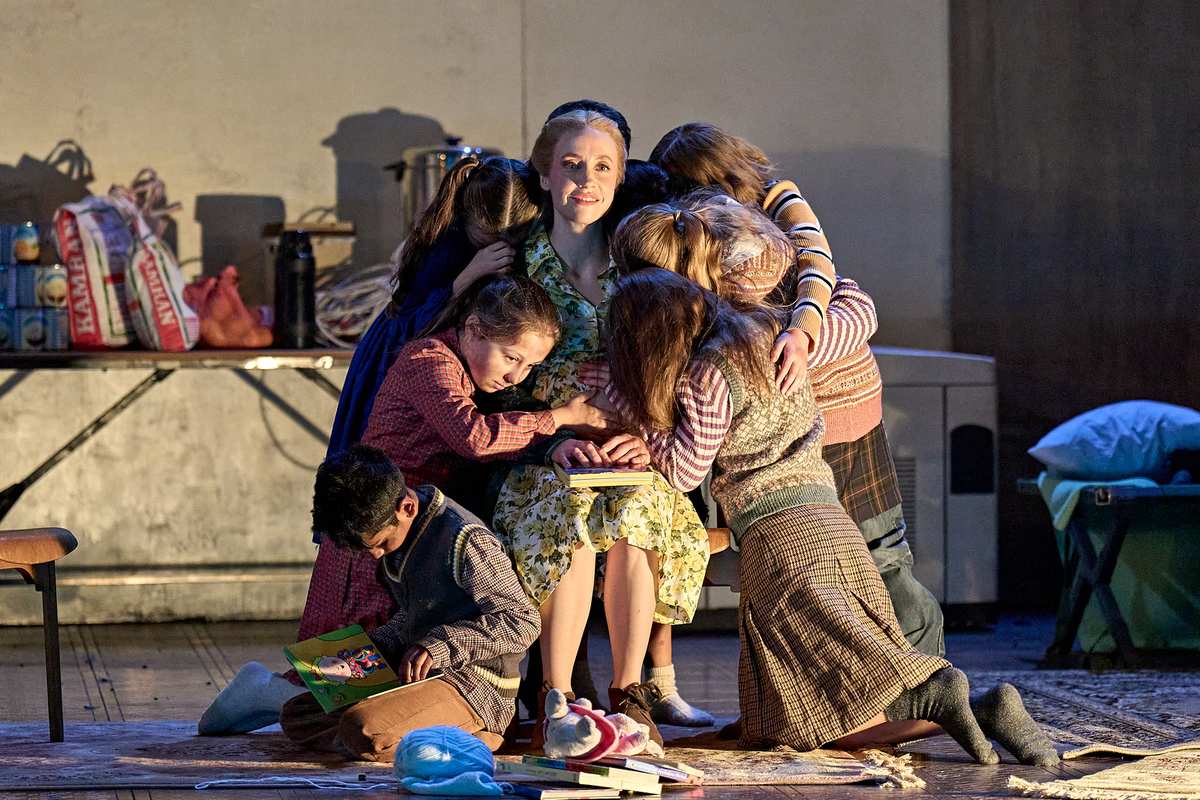 Adriana Mater at London Coliseum. Photo by Manuel Harlan
Composed by Finnish-born Kaija Saariaho (who died in 2023) with a libretto by Amin Maalouf a Lebanese-French writer, former journalist and war correspondent, the opera is difficult to categorise beyond such terms as modernist, mathematically spectral and expressionist. It is certainly filled with good intentions. There also seems to be a degree of nepotism at play, with the clunky English translation (who on earth uses words like ingurgitation?) provided by the composer’s son Aleksi Barrière. Her daughter Aliisa Neige Barrière also gets a look-in for two performances, as associate conductor.
Unfortunately, most of the first half is a fairly tepid affair. We’re at, what looks to be, a local community centre in considerable disarray. The main door is barricaded and Adriana (German mezzo-soprano Kristina Stanek) is stolidly rebuking the perpetually drunken advances of a young Tsargo whilst her eyes are unflinchingly fixed on conductor André de Ridder. She is variously supported and upbraided by her elder sister Refka (an impressive debut by soprano Lauren Fagan).
Various so-so, tableaux, come and go, interspersed with black screen onto which are projected the lyrics of the singers behind. It’s an odd design choice to say the least (from Rosanna Vize) falling somewhere between bleak and lazy. I wasn’t sure which seemed the more reasonable interpretation.
After the interval it’s all guns blazing as we land in the restored location twenty years on, amidst a fractious argument which has erupted between mother and son. Yonas (tenor Caspar Singh), wearing jeans topped by a shell suit jacket and sporting a mullet, has a terrific voice but demonstrated a cringeworthy inability to act, perhaps due in part to some of the awful lines he was required to deliver (at one notable moment he rails at having been constrained by the straight jacket of ignorance etc). His awkward movement was mirrored by a general physical frigidity in the company. Perhaps director Annilese Miskimmon and movement director Imogen Knight were aiming for a sense of emotional disconnect born of war trauma. The overall result manifested as a collective of stilted onstage presences who loom but never truly burst into life.
Having discovered his mother and aunt have lied to him and that he was the product of a rape and that his father is still alive, Yonas determines to exact revenge. His mother refuses ovations to try and stop him, bleating repeatedly “If he kills, he is a killer”. It essentially telegraphs the intention of the writers. If Yonas fails in his attempt to challenge and murder Tsargo (baritone Leigh Melrose) who by this time is almost pitiable and near-blind, then he is more his mother’s son than his father’s and the spell will be broken. Love will have won and the ‘environment over genetic disposition’ argument will have been proven.
Having witnessed seemingly countless Carmens, Toscas, Flutes and Traviatas during my lifetime, I always look forward to anything new and unknown to me. Certainly much of the music here has strains akin to Britten but ADRIANA MATER proved possibly one of the most dour and disappointing productions I have witnessed in a long time, and it wasn’t the subject matter which was at fault. By comparison “Dead Man Walking” at this house a year ago, was breathtaking, original and superbly executed.
The production - should you dare to experience it for yourself — continues for a further six performances during December, on 1st, 3rd, 5th, 8th, 10th and a final matinee on 12th.
Latest News
 Review: ADRIANA MATER at London Coliseum
29 November 2026 at 12:38
 Review: THE SANTA CLOSET at The Pearly Queen Theatre
28 November 2026 at 08:31
 Review: FEELING AFRAID AS IF SOMETHING TERRIBLE IS GOING TO HAPPEN at The Other Palace
27 November 2026 at 11:30
 Review: CLUB NVRLND at The Vaults
27 November 2026 at 10:42