
Review: MILLION DOLLAR QUARTET at The Arts at Marble Arch
Equal parts documentary and jukebox musical, Million Dollar Quartet is a dramatised retelling of and a fascinating look into a pivotal moment in rock ‘n’ roll history. Led by the original cast from the Barn Theatre production, Colin Escott and Floyd Mutrux’s musical sets out to celebrate but also humanise these four musical legends, and the result is equal parts joyful and moving.
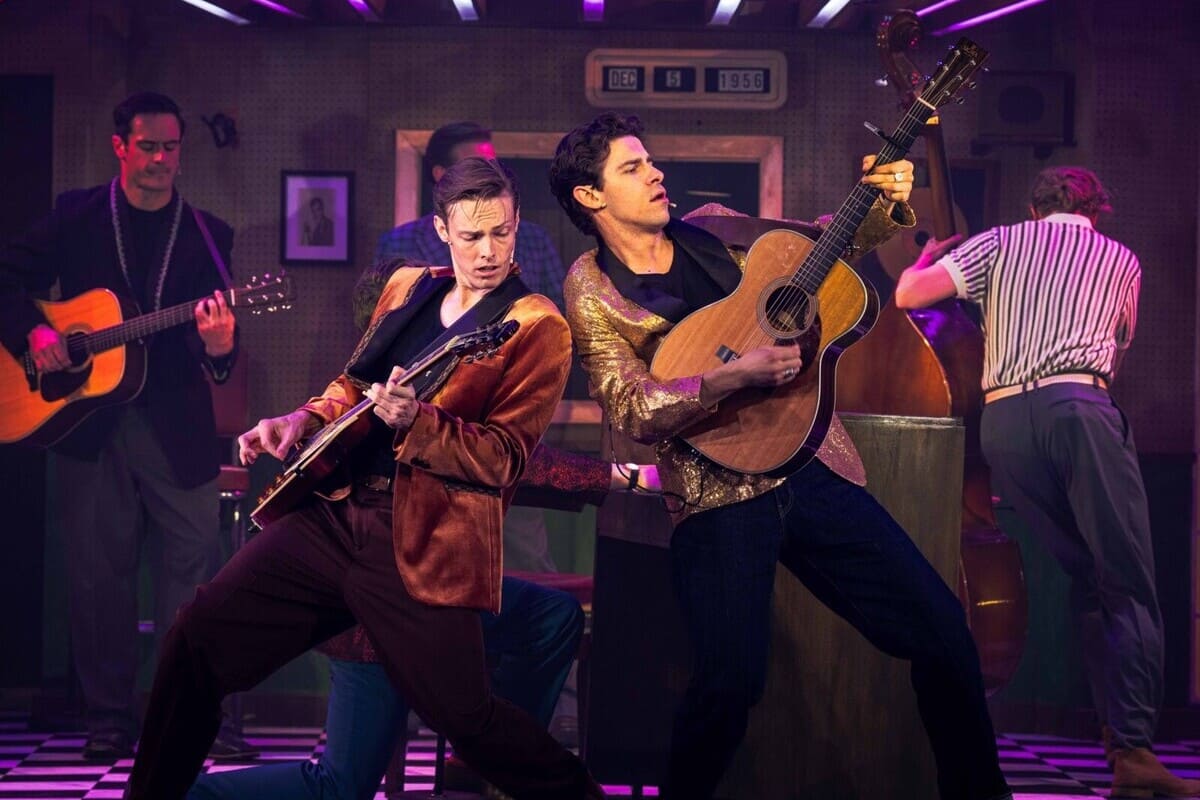 Connor Payne and Joey Bradick in Million Dollar Quartet. Photo by Alex Tabrizi
On 4th December 1956, Elvis Presley, Johnny Cash, Carl Perkins, and Jerry Lee Lewis walked into a recording studio - what sounds like the opener to a joke ended up being the impetus for an impromptu, improvised jam session, the first and last of its kind. All at different points in their careers, reunited at Sun Studio in Memphis where they were launched into stardom by record producer Sam Phillips, they were dubbed a "million dollar quartet” by the Memphis Press-Scimitar - a moniker so catchy it seemed destined to inspire a musical fifty years later.
For the cast, these are demanding roles: how do you portray a musical icon with an ultra-recognisable singing voice without sounding like an Elvis impersonator at a Vegas casino? But the four actors rise tremendously to the task, copying their real life counterparts' voices, mannerisms, expressions, and movements while also imbuing them with a sense of authenticity: embodying rather than impersonating.
Connor Payne had perhaps the biggest challenge in this respect as Elvis Presley, but he flawlessly mimics Elvis's swagger, boyish charm, and distinctive dance style without ever falling into caricature. Christopher Erasmus is equally effective in capturing Johnny Cash's memorable bullfrog-deep voice (though it sounds a bit more artificial during his spoken dialogue) and brooding, morose expression. Joey Bradick brings a depth of character to Carl Perkins, balancing his professional confidence with his innate insecurity and resentment about being overlooked. Most entertaining of all is Joe Bence as Jerry Lee Lewis, who brims with charisma, cheekiness, and comedic timing, whether he's earnestly and unabashedly showing off his talent at the piano or grinning as he tells a morbid story about his brother's death.
Darren Day also shines as Sam Phillips, our narrator and ringmaster who guides us through the story with his charming Alabaman accent (I was especially fond of the way he pronounced 'guitar' as 'gee-tar'), witty aphorisms, sarcastic asides, and the occasional breaking of the fourth wall to crack jokes with the audience. Although he lingers in the sidelines and allows the musicians to take centre stage, he very much feels like the heart of the story. He refers to the quartet affectionately as "my boys" and they in turn call him "the father of rock 'n' roll". Jenay Naima as Dyanne (based on the real-life Marilyn Evans, who was dating Elvis and tagged along to the studio that day) counterbalances the male energy in the room, holding her own against the quartet with her dazzling vocals.
The soundtrack is, of course, the real highlight of the show, especially in the hands of a truly talented cast of vocalists and performers, including Geraint Downing and Josh Haberfield on the double bass and drums. Each musical number manages to stand out, with special mention going to 'Folsom Prison Blues' and 'Sixteen Tons' for sheer chills-down-your-spine energy and 'I Walk the Line' for being a hauntingly beautiful rendition of a classic. 'Down By the Riverside' allows each of the quartet a moment to shine before they come together in perfect harmony, and 'Great Balls of Fire' is an inevitable crowd-pleaser, packed with truly infectious energy and pizzazz.
The musical doesn't concern itself with plot - the only real sense of dramatic tension comes from each man's desire to fulfill his career ambitions and the question of who if anyone will sign a renewal contract with Sun Studio. Beyond that, it feels like a concert with some storytelling interludes thrown in that flesh out the characters through their conversations and arguments. This does get repetitive after a while, but Phillips' narration keeps it fresh and engaging as he peppers the story with context, commentary, and reminiscence. As each member of the quartet performs, we're shown an onstage flashback of his first meeting with Sam, depicting how far he's come from where he started out. It's a tad cliche, but also deeply poignant, especially when Phillips remarks that for all the fame these men achieved, he wishes they'd had happier lives.
In many ways, the atmosphere feels like a concert: lively and electrifying, with the audience dancing in their seats during the finale. But it simultaneously manages to evoke a sense of improvised spontaneity, as if we're really watching a group of musicians just play around with different sounds, caught up by a love for music. It makes for a truly intimate experience.
The stage design adds to this sense of intimacy and immersion. Libby Watson's set is delightfully retro, with a black and white chequerboard floor, framed photographs and records on the walls, cluttered with vintage memorabilia. A large proscenium frame lined with marquee bulbs creates the sense of a show within a show, while Alex Musgrove’s lighting design shifts effectively from warm, cosy lighting during quiet scenes to sharper spotlights during performances. Despite being set entirely within the recording studio, the stage never feels static.
The musical is also packed with historical details and in-jokes. Phillips' off-hand, dismissive comment about signing someone called Ray Orbison and Elvis's declaration that he "ain't never playing in Vegas again" earned chuckles of appreciation from the audience. References to Elvis being dominated by his new agent, 'the Colonel' (the infamous and controversial Tom Parker) and Carl Perkins' disgruntlement over Elvis getting credited for his song 'Blue Suede Shoes' serve to evoke the wider historical context outside the far walls of the studio and an awareness of the legacy of these four musicians and the future of rock 'n' roll.
In this way, Million Dollar Quartet is tinged with a sense of melancholy for a bygone era of music - and you could see the emotional impact this had on audience members, particularly those who grew up with this music. But it's also a joyful tribute to this era and the people who shaped it. It strikes a clever balancing between documenting and dramatising a moment in history, commenting on the nature of fame, legacy, and how music continues to evolve with the times - while also unabashedly having fun with it. You can tell the actors are having a blast, and inevitably, the audience does too.
Million Dollar Quartet Tickets
Latest News
 Review: MILLION DOLLAR QUARTET at The Arts at Marble Arch
16 September 2026 at 18:30
Review: MILLION DOLLAR QUARTET at The Arts at Marble Arch
16 September 2026 at 18:30
 Review: GOLDEN BOY at Almeida Theatre
16 September 2026 at 00:05
Review: GOLDEN BOY at Almeida Theatre
16 September 2026 at 00:05
 Cast announced for one-part production of HARRY POTTER AND THE CURSED CHILD
15 September 2026 at 11:54
Cast announced for one-part production of HARRY POTTER AND THE CURSED CHILD
15 September 2026 at 11:54
 LEGALLY BLONDE to transfer to the West End with Amber Davies reprising her role
15 September 2026 at 10:58
LEGALLY BLONDE to transfer to the West End with Amber Davies reprising her role
15 September 2026 at 10:58