
Review: FRANZ & MARIE at Charing Cross Theatre
How does an unfinished German tragedy inspire a musical written by a Kentish indie folk band, produced by a Korean theatre company and staged in London? Franz & Marie has a slightly fragmented history, and it often feels like a fragmented production, uncertain of what it’s trying to be, but the overall effect is hauntingly beautiful to behold.
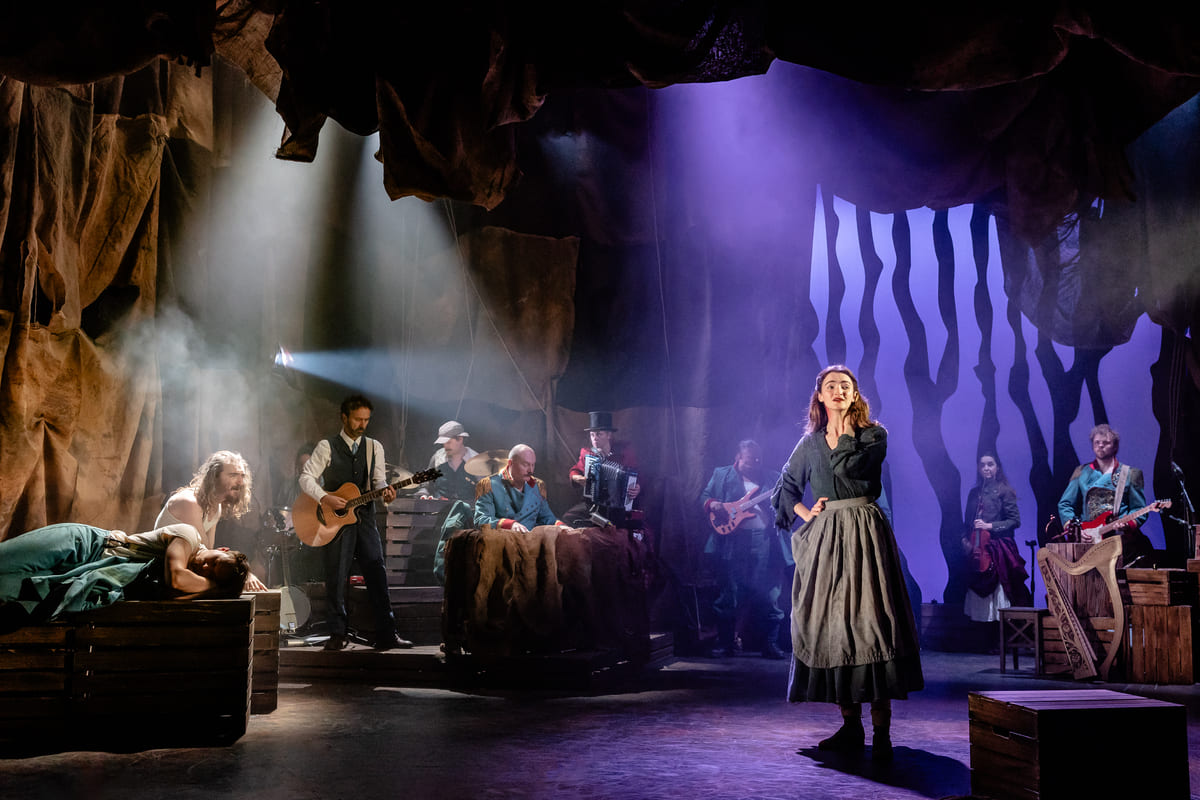 The cast of Franz & Marie. Photo by Danny Kaan
Franz Woyzeck is a soldier whose platoon is posted in a remote outpost, plagued by PTSD from his time in the war and fiercely devoted to his girlfriend Marie and their baby Georgie. Desperate to provide for them, he volunteers for a medical experiment under the sinister Dr Simian, which only serves to worsen his mental health - especially when he begins to suspect that Marie has been unfaithful to him.
The history behind this musical is a fascinating one. It’s adapted by Teresa Howard from Georg Buchner’s Woyzeck, a famously unfinished 19th century play that itself was inspired by a real-life murder trial, the first in Germany where the defence relied on an insanity plea. Twenty years ago, it was commissioned into a musical adaptation by Korean theatre company Acom, with music and lyrics by Chris Broderick and Rob Shepherd of the Singing Loins.
Woyzeck is considered to be the first modernist drama, and the story certainly feels very modern in its exploration of mental health, toxic masculinity, classism, dehumanisation, and militarism. It's also the first example of a true working class tragedy, where the common folk are centred instead of being on the periphery of the stories of aristocrats, who here are fashioned as villainous and clownish figures.
With such themes, it's unsurprising that the musical feels devastatingly bleak in tone, painting a picture of a brutal, seedy society where those on the margins are oppressed by a vicious hierarchy. But it's also filled with moments of black comedy woven seamlessly into its macabre story in a way that feels like social satire. When Franz seeks to buy a murder weapon, we're treated to a comical musical number about the different varieties of knives on sale. Dr Simian's horrific lack of empathy towards Franz's treatment during the experiment is offset by his medical students' outrageously blase lack of reaction. The style of humour works well, and suggests a world gone so far off the edge that humour is the only coping mechanism.
But what really makes this unique musical work is its brilliantly talented 14-strong cast of actor-musicians. Brenock O’Connor gives a heartbreaking performance as Franz, embodying his frailty in both his erratic physical movements and the emotional resonance of his singing voice. Mark Meadows as Captain Peccary and Steve Simmonds as Sergeant Ustid bring a buffoonish sort of villainy to their roles which is as entertaining as it is sinister. Eve Polycarpou is particularly compelling as Vashti, our de facto narrator, who is reminiscent of a cackling, chaotic witch from a fairy tale. Jane Oswald is charismatic as Marie but feels a bit wasted as a character who primarily exists to prop up Franz's - despite the production's attempts to give her more agency, including adding her name to the title.
The indie folk score works beautifully with the bleak, rustic, and eerie setting and storytelling. The eclectic soundtrack ranges from heartfelt ballads like ‘Inconsolable Boy’ to energetic ensemble numbers like the catchy tavern song ‘The Pub on the Corner’. O’Connor and Oswald are particularly powerful in emotional duets like ‘Shelter’ and ‘Lay Me Down Love’. The gypsy characters are especially memorable with their carnivalesque numbers like 'Funfair' and 'The Knife Song', which shift erratically from quaint and charming to nightmarish and unhinged.
All the performers play a variety of folk instruments - accordion, jingle stick, tin whistle, violin - and remain onstage throughout, making the music a consistent accompaniment to the story. The production utilises a folk-indie style of communal storytelling rather than conventional musical theatre arrangements. The ensemble's constant presence also creates a sense of claustrophobia as the plot progresses, particularly as the musical style grows more discordant and oppressive as Franz's mental state deteriorates.
But while the music is distinctive and memorable, the setting and world-building of the story feel a little vague. There are strong Slavic influences in the aesthetics, and the musical appears to take place in a 19th century Central European setting, but we don't get a strong sense of place. We're told there's an ongoing war that had Franz's platoon fighting in a desert, but no further context is given. Dr Simian and his nefarious human experimentation feel somewhat Nazi-esque, while the accents and colloquialisms are distinctly British. But the vagueness gives the musical a surreal sort of charm, and an almost fairytale-like quality, as if it exists outside any particular place or time.
Beretta Gerecke’s set embodies this folkloric, dreamy atmosphere. It is simple, with wooden crates used to depict stalls, beds, and barracks, while semi-transparent hessian curtains shift around to signal a change of location. Lighting by Christopher Nairne and sound by Andrew Johnson and Oscar Cotran are especially effective in evoking Franz’s PTSD episodes through smoke and echoing gunshots, creating the impression of reality itself fracturing.
The storytelling itself is a bit shaky and often predictable, even cliche - the love story's beats are familiar and it’s clear from the onset what the tragic conclusion will be. And yet Buchner's story, though it only exists in disconnected scenes and sketches, has influenced and been adapated into multiple genres including opera, theatre, ballet, puppetry, and film. Hojin Yun, artistic director of Acom, comments, in the programme notes, that Woyzeck’s portrayal of young men forced into military service particularly appeals to Korean audiences. Simultaneously, the Singing Loins' raw folk style blends seamlessly with its storytelling, and the focus on classism resonates with British audiences.
There's a universality to this story that makes it appealing and also malleable, lending itself easily to myriad interpretations and retellings. In this way, Franz & Marie feels both ancient and modern as a musical, embracing its own fractured origins to create something that's dark, discordant, eerie, and yet poignant.
Latest News
 Review: FRANZ & MARIE at Charing Cross Theatre
7 October 2026 at 13:59
Review: FRANZ & MARIE at Charing Cross Theatre
7 October 2026 at 13:59
 Casting announced for the UK premiere of THE PELICOT TRIAL
6 October 2026 at 12:08
Casting announced for the UK premiere of THE PELICOT TRIAL
6 October 2026 at 12:08
 RENT extends booking and releases new production images
6 October 2026 at 11:37
RENT extends booking and releases new production images
6 October 2026 at 11:37
 Glenn Close to play Herod in final week of JESUS CHRIST SUPERSTAR
6 October 2026 at 11:17
Glenn Close to play Herod in final week of JESUS CHRIST SUPERSTAR
6 October 2026 at 11:17