
Review: SPACE DOGS at The Other Palace
Off-Broadway transfer Space Dogs is as bizarre as it sounds: equal parts musical, stand-up comedy, rock concert, and history lesson. And yet remarkably, it manages to be fascinating and poignant as much as it’s wildly entertaining.
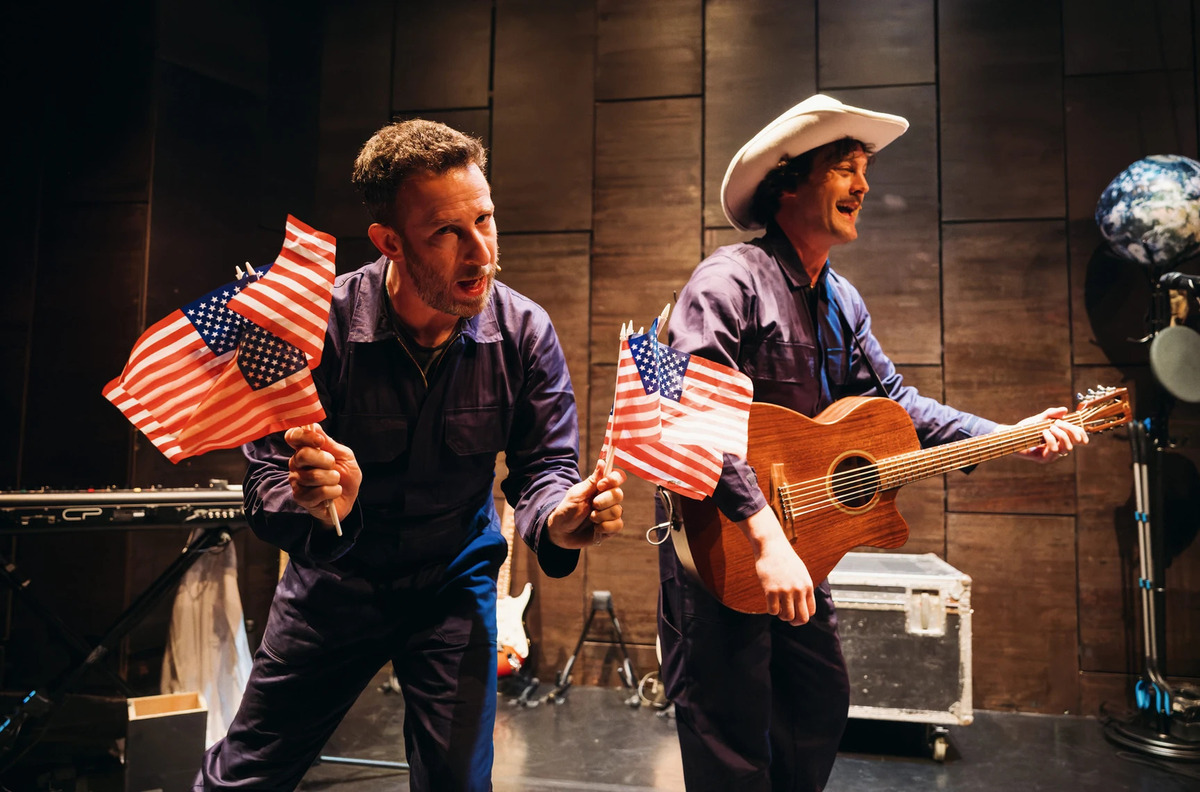 Nick Blaemire and Van Hughes. Photo by Alex Brenner
Written and performed by Nick Blaemire and Van Hughes, this one-act two-hander tells the true story of forty stray dogs recruited into the Soviet space programme during the Cold War. With the USA and the USSR competing fiercely to get ahead in the space race, the Soviets finally managed to send the first living creature into space on 3rd November 1957: Laika, “the loneliest dog in the world.”
“History is tactile,” we’re told as the show opens, with Blaemire and Hughes flinging stuffed dogs into the audience for us to catch. This immediately sets the tone for the rest of the show: interactive, intimate, funny, and a touch absurd. Tonally, the show often feels like it was made by stoners for stoners, juggling that fine line between bizarre and profound, with quips like “the brain named itself”, and songs that go in circles. It couldn’t have worked as well as it did without Blaemire and Hughes at the helm; the pair have remarkable chemistry and play off each other’s energy without faltering, occasionally pretending to have gone off script or lost their flow, which gives the show a lot of its charm and authenticity.
The show’s pace is high-octane, rapid-fire, and sometimes a little too chaotic, as Blaemire and Hughes jump between characters across the USA and the Soviet Union, transforming dizzyingly with a shift in accent or the addition of a lab coat. They dash around the stage, playing keyboards and guitars, changing costumes, and grabbing props. The show relies a lot on our imagination, with a relatively minimalist set and simple props. We depend on Blaemire and Hughes’ narration and storytelling prowess to transport and immerse us: the ding of a bell signifies a change of scene, shifts in lighting take us to different locations in the story, a trunk becomes a space shuttle, and so on. Their conviction makes it utterly believable. In the small space of The Other Palace Studio, it also feels deeply intimate.
The score is a bit hit and miss, but entertainingly eclectic. There are rock numbers, heartfelt ballads, and raps, shifting in genre to reflect the story’s shifting tone, sometimes moving and other times laugh-out-loud funny. There are some moments of lyrical genius and other times where the lyrics don’t quite land, but there’s no arguing that Blaemire and Hughes are incredibly vocally talented, with enough charisma to make the whole experience feel like being at a rock concert.
And what about the real stars of the story, the dogs? They’re represented by stuffed toys, with Blaemire and Hughes doing the voices for them. It could’ve been kitsch, but the result is actually deeply endearing and moving. It’s impossible not to get invested in the little stuffed Laika with her ‘Dear Diary’ segments where she narrates her thoughts to us. The emotional core of the story becomes the bond between Laika, voiced by Blaemire, and the nameless (up until the end - his name was never revealed to the public until a decade after his death) Chief Designer, whose fondness for her conflicts with his loyalty to his country.
The show is packed with wild historical details - such as the US intelligence programme that recruited Nazi scientists, and the hasty launch of Sputnik 1 being the result of an American communication being misunderstood - making it fascinating for Cold War history buffs. The historical facts are delivered with pizzazz, irony, and exaggeration, without detracting from their real-world implications - and the unsettling parallels with modern-day geopolitics.
Underneath the satire and silliness is a deeply tragic story of the innocents who suffer the cost of human ambition. “Propaganda is art,” Blaemire and Hughes remind us over and over, and go a layer deeper by pointing out that even the story they’re telling us is a form of propaganda, because it’s their version of history. They demonstrate this with their reluctance to tell us about Laika’s tragic end, as if by withholding it they have a chance of undoing the horrible injustice that was done to the little dog we’ve become so emotionally invested in.
Space Dogs is a clever show - unique in its concept and execution, carefully straddling the line between absurd and moving, satirical and serious, and overall charming.
Latest News
 Production photos released for world premiere of THE PIANIST
14 September 2026 at 17:23
Production photos released for world premiere of THE PIANIST
14 September 2026 at 17:23
 Full cast and rehearsal photos released for THE LIVES OF OTHERS
14 September 2026 at 16:43
Full cast and rehearsal photos released for THE LIVES OF OTHERS
14 September 2026 at 16:43
 Revival of SUNDAY IN THE PARK WITH GEORGE cancels its 2027 run
14 September 2026 at 13:05
Revival of SUNDAY IN THE PARK WITH GEORGE cancels its 2027 run
14 September 2026 at 13:05
 Review Roundup: BLOODSPORT: AFTER HELEN OF TROY at Theatre Royal Stratford East
14 September 2026 at 10:31
Review Roundup: BLOODSPORT: AFTER HELEN OF TROY at Theatre Royal Stratford East
14 September 2026 at 10:31