
Review: STOKER WILDE at Wilton's Music Hall
It’s a rare and fun opportunity to see a musical in its earliest stages as a developmental concert, a stripped back version that allows you to see the potential shining through the bare bones of the story and the music. And Stoker Wilde certainly has a lot of potential.
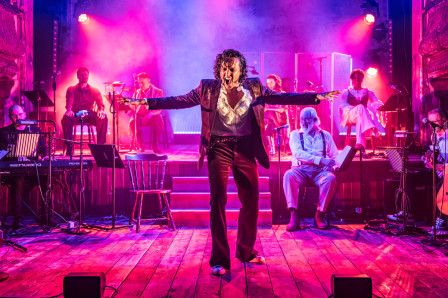
 Glenn Anderson as Oscar Wilde in Stoker Wilde. Photo by Marc Brenner
The musical explores the friendship-turned-rivalry between Bram Stoker and Oscar Wilde: both Dublin-born Irish writers, Trinity College alumni, and soon-to-be literary giants. Over the course of many years, their paths cross and often clash: Stoker marries the woman Wilde was courting. Both move to London, where Stoker works managing the Lyceum Theatre while Wilde cultivates a brilliant but dangerous reputation. And along the way, inevitably inspired by each other, they will write their greatest works: Dracula and The Picture of Dorian Grey.
Eric Rosen’s book is clearly well-researched, peppered with delightful historical details, callbacks and call-forwards alike - though it often plays fast and loose with historical accuracy, incorporating anachronisms and modern slang, which work well with the musical’s contemporary tone and musical style. On a mostly bare stage with the actors moving minimally between chairs to show a change of scene, our attention is entirely focused on the language and the actors' body language to convey storytelling.
The musical is at its most fascinating when it spotlights the back-and-forth between Stoker and Wilde: their differing approaches to their craft, and the idea of morality in arts vs art for art's sake, as well as their differing approaches to their own queerness. Oscar makes little attempt to hide his sexuality, while Bram prefers to remain in the shadows - historically, Stoker's sexual orientation was never definitively known, though literary critics have ascribed a queer reading to his work. This exploration of the realities of being queer in 19th century Britain is the emotional core of the story, and its most poignant aspect. Notably, and perhaps in reference to the don't-ask-don't-tell discretion of the era, queerness is never explicitly mentioned, but rather implied through innuendo and euphemisms such as "people like us".
In the seven-strong cast, Glenn Anderson is absolutely the stand-out as Oscar Wilde. He manages to simultaneously embody a flamboyant dandy and a sexy, charismatic rockstar (who occasionally strokes the mix cord sensually) in both his delivery and his stunning vocal performance. Christina Bennington brings a deeply compelling quality, both fierce and vulnerable, to aspiring actress Florence Balcombe, whose marriage to Stoker (“not lavender, but evergreen”) is both heartwarming and heartbreaking. David Bedella as stage legend Henry Irving is a thrill to behold, with impeccable comedic timing and a charm that shifts seamlessly between campy and intimidating. Jemma Geanus as his co-star Ellen Terry is equally formidable.
Connor Carson - who to his credit stepped into the role of Stoker at short notice after Jamie Boyogo was forced to withdraw due to an injury - feels a little flat in comparison, but perhaps this flatness is a reflection of Stoker being so repressed. Regardless, he and Anderson have electrifying chemistry as the leads. The musical imagines a brief romantic liaison in their past, and the two actors seamlessly weave in all the complex layers of their relationship: lovers, friends, and rivals who equally sabotage and inspire each other, engaging in a subtle brand of flirtation by writing each other into their works.
The score is a joy to experience in the acoustics of the beautiful Wilton's Music Hall, which feels appropriately gothic, particularly with the use of moody, ambient lighting. The musical is at its best when it delivers big, campy, glam-rock numbers like 'Famous or Notorious' and 'The Picture of Dorian Gray' - less so when it veers into more on-the-nose emotional ballad-like songs. It might benefit from trimming some of the musical numbers, allowing the storytelling and drama a bit more breathing room.
Pacing wise, Stoker Wilde jumps around a bit erratically between key historical moments, and one would hope the future full version of the musical would slow down slightly to expand on the backstory and relationship between Stoker and Wilde. That is where the storytelling really shines, along with the moments when it really fleshes out the era in which these two literary giants lived, with an exploration of the changing nature of theatre and art, the fear of censorship, and the interplay between queerness and horror writing.
Stoker Wilde is clearly a labour of love, and has all the ingredients to be a hit: a score that feels both gothic and rock n roll, compelling characters, a fascinating historical setting - literature lovers will thrill at the chance to see where the inspiration of Dracula and The Picture of Dorian Gray came from - and a subtle but moving tribute to the queer voices in literature.
Latest News

 Park Theatre announces casting for MISS BENNETT: CHRISTMAS AT PEMBERLEY
30 October 2026 at 15:39
 MOULIN ROUGE! THE MUSICAL releases new production photos
30 October 2026 at 15:16
 Review: STOKER WILDE at Wilton's Music Hall
30 October 2026 at 13:30

 Review: THE MOTH at Finborough Theatre
30 October 2026 at 00:00