
Review: LOVE'S LABOUR'S LOST at Shakespeare's Globe
The advantage of staging one of Shakespeare’s lesser known plays is that it gives a director the liberty to put their own spin on it, no matter how outlandish. And that’s exactly what Indiana Lown-Collins does with this flamenco-infused production of Love’s Labour’s Lost which works so much better than you would expect: joyful, flamboyant, creative, and utterly unique in its take on a play that’s left many a critic scratching their head.
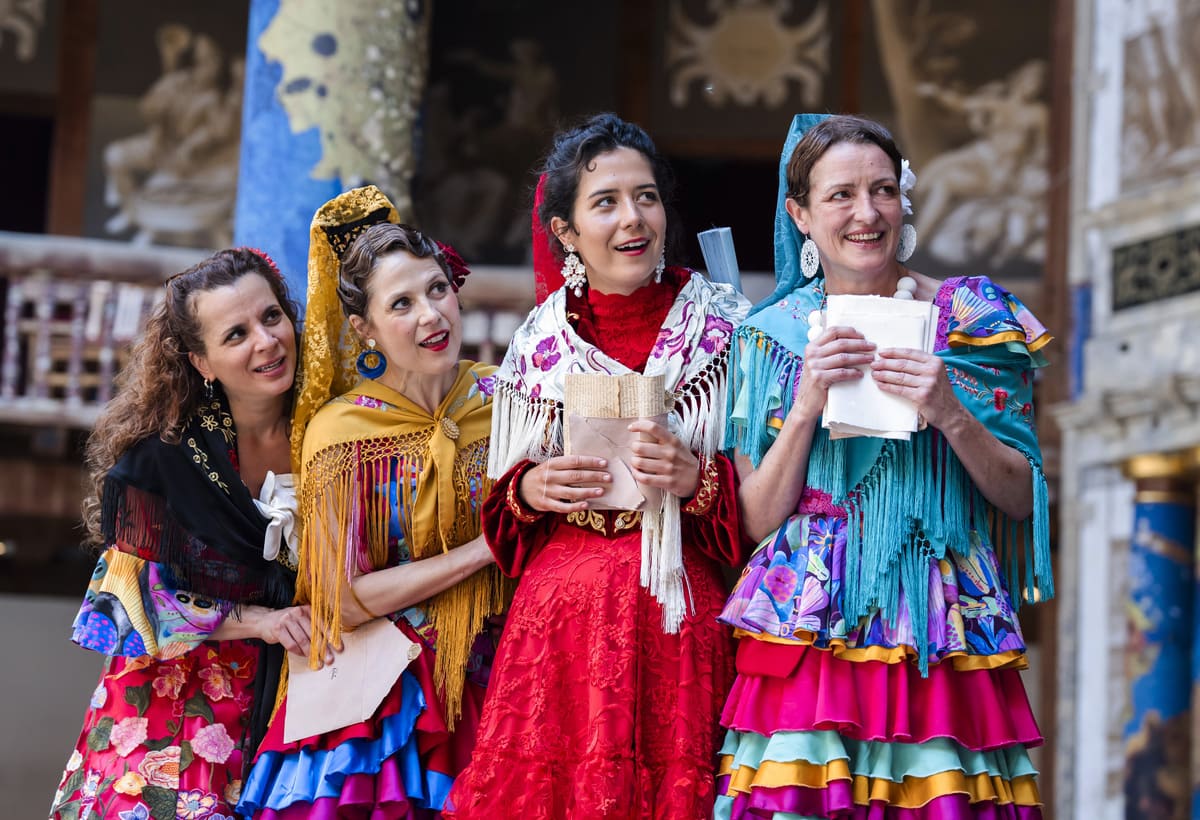 The cast of Love's Labour's Lost. Photo by Maisie Allen.
The King of Navarre and three of his lords take a vow to dedicate themselves to study by swearing off worldly pleasures - including women. Enter the Princess of Spain (France in the original text) and her ladies-in-waiting, visiting Navarre on a diplomatic mission. The four men immediately fall in love, forswearing their vow, and hilarity ensues.
Love’s Labour’s Lost is considered one of the trickier plays to stage, with an often shaky plot that veers off into confusing sub-plots, including a rather random play-within-a-play. Its dense language (probably written for the students of the Inns of Court rather than bawdy playhouse audiences) is packed with Latin rhetoric and knotty wordplay, and its ending is famously, shockingly melancholy for a comedy.
Lown-Collins doesn’t attempt to bypass any of these issues, instead redirecting our attention to the production’s bold new flamenco theme. It could’ve very easily felt gimmicky, but instead it’s woven seamlessly into the narrative of the play, with the dance form used in creative and charming ways. Flamenco performances open and close the play, bookend significant scenes, and are used to express emotion when language is not enough. As a dance form, flamenco is driven by passion and emotion, with every foot stomp and head jerk packed with meaning and storytelling. One of the most visually stunning scenes in the play is a dance interpretation of a bullfight (a deer hunt in the original text) performed by the Princess, which is visceral, aggressive, and thrillingly beautiful to watch.
There are only two professional flamenco dancers in the company, Pablo Egea and Anita La Maltesa, but the entire cast participates in the dancing, wearing heeled wooden shoes that make a delightfully emphatic clatter on the wooden boards of the Globe stage. The musicians are a constant presence onstage, engaging with the action as much as they accompany it with their music, alongside singer Carlos Lobo Cordon, whose rich, haunting voice forms the backdrop to the vibrant dance sequences. Lown-Collins’ direction and Carmen Igarza’s choreography allows the dance and the language to work together in tandem, with percussive hand claps punctuating some of the repartee between characters.
Unsurprisingly, the production leans more heavily (and joyfully) into the play’s Spanish setting than Shakespeare’s text ever does. The Latin puns are replaced by sprinklings of Spanish, untranslated. Tonally, as well, the production seems to emulate a Spanish telenovela, with over-the-top acting and a gleeful sense of melodrama. Fittingly and delightfully, this being the hottest day of the month, you could see hand fans flapping throughout the theatre as audience members tried to stay cool and unwittingly found themselves matching the play’s scorching Andalusian aesthetics.
Kate Lias’s set design feels vibrantly Iberian, dominated by royal blue and yellow-gold in the spray-painted columns and matching tiled back panels. The musicians and flamenco dancers blend in with the colour scheme in their blue and yellow costumes. The king and his lords wear white with gold accents, signifying their self-imposed repression, and the ladies wear bold, colourful costumes with textured ruffles and flowers in their hair, symbolising the opposite. The Princess stands out from the rest of the cast in a regal, form-fitting pantsuit of matador red, immediately placing her at the forefront of the narrative.
The characters feel slightly flatter than what we’re used to in later Shakespeare, but the cast stuns nonetheless, bringing dramatic flair and impeccable comedic timing to their roles. The women are really the stars of the show, driving the action and commanding the narrative while the men, in comparison, are foppish and clumsy, though still endearing. Norah Lopez Holden is especially formidable as the Princess, utterly magnetic, fierce, and self-confident in every scene. Equally charming is the romance between Bea Segura’s sharp-witted Rosaline and Philip Adritti’s dashing Berowne, who feel like a prototype to Beatrice and Benedick.
What the play lacks in complexity of plot, it makes up for in wit and wordplay: banter, puns and wordplay, long-winded jokes, love letters and poems. The production leans into this medley of linguistic confusion, emphasising sex jokes and comical misunderstandings through physical comedy. It also unapologetically embraces the play’s silliness: the king and his lords their love for the ladies by setting Shakespeare’s words to the tune of modern pop songs like ‘Despacito’ and ‘Livin’ La Vida Loca’. The pageant of the Nine Worthies at the end is played with the maximum flair and chaos, featuring giant-headed puppets representing famous historical figures.
Flamboyant is the best way to describe the production - it’s over-the-top and melodramatic in tone, aesthetic, and acting. The actors clearly have a lot of fun with it - so inevitably, the audience does as well.
Latest News
 Production photos released for world premiere of THE PIANIST
14 September 2026 at 17:23
Production photos released for world premiere of THE PIANIST
14 September 2026 at 17:23
 Full cast and rehearsal photos released for THE LIVES OF OTHERS
14 September 2026 at 16:43
Full cast and rehearsal photos released for THE LIVES OF OTHERS
14 September 2026 at 16:43
 Revival of SUNDAY IN THE PARK WITH GEORGE cancels its 2027 run
14 September 2026 at 13:05
Revival of SUNDAY IN THE PARK WITH GEORGE cancels its 2027 run
14 September 2026 at 13:05
 Review Roundup: BLOODSPORT: AFTER HELEN OF TROY at Theatre Royal Stratford East
14 September 2026 at 10:31
Review Roundup: BLOODSPORT: AFTER HELEN OF TROY at Theatre Royal Stratford East
14 September 2026 at 10:31