
Review: TOY SOLDIER at Union Theatre
Toy Soldier, written and directed by Helen Goodman, is a single-act performance showing at the Union Theatre until 18th October. It’s an exploration of how war, in this case the conflict in the Falklands, builds secrets and breaks down relationships within families, leaving long-lasting repercussions.
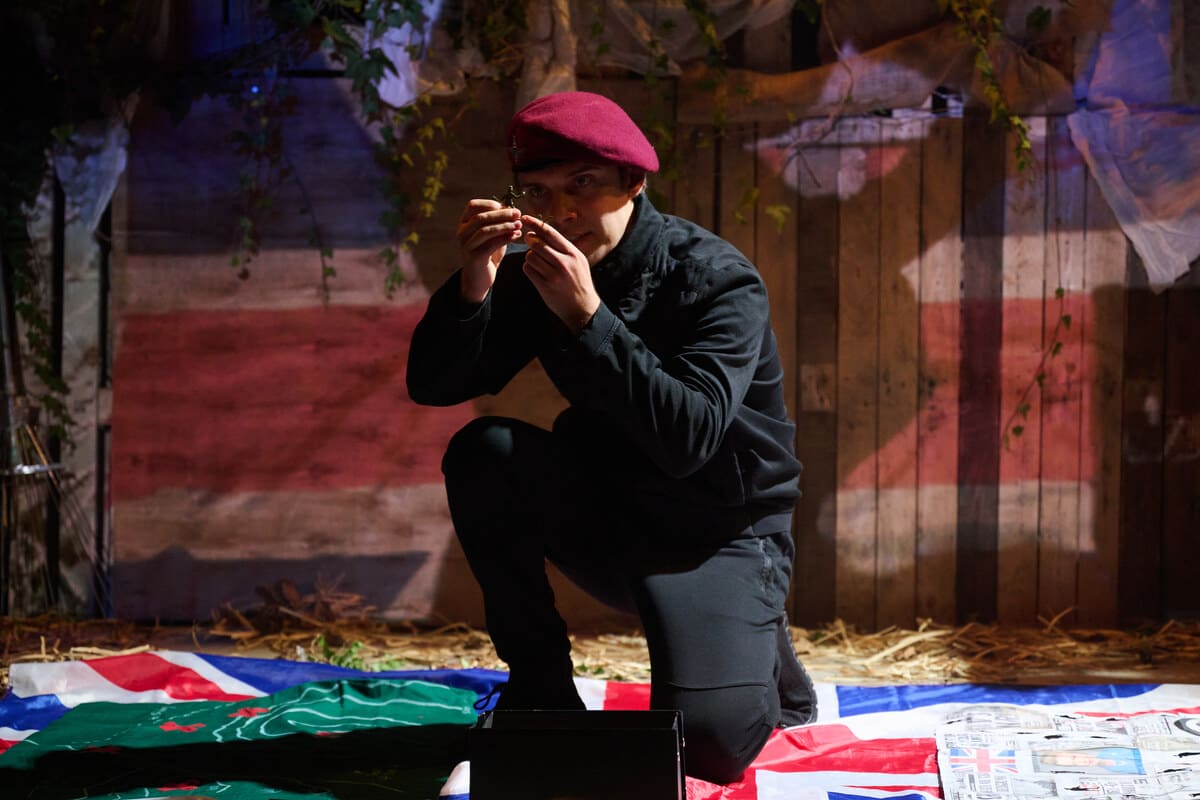 Photo provided by production
Toy Soldier starts in 2002, when Jane is packing up her family home in the Falklands, following the death of her mother. Whilst doing so, she finds an old tape which transports her mind back 20 years, to the midst of the conflict in the Falklands. In 1982, Jane lives on her family farm with her negligent mother and younger brother Billy, when the conflict breaks out. Whilst working the farm, she finds Alejo, an Argentine soldier, wounded and hiding on their land. Led by her compassion, she decides to help him, bringing him food, water and blankets, and tending to his wounds all while keeping him a secret from the rest of her family. Meanwhile, Billy is growing increasingly frustrated with the restrictions that the conflict has put on his life. He finds a sympathetic ear in his friend Mark, who shares Billy’s sentiments and plans to act on them. Billy becomes influenced by Mark’s views, which are more radical-leaning and are founded in an “us versus them” mentality, as he calls for violence and hatred towards the Argentinian soldiers. Jane’s secret and Billy’s new ideas begin to break down the relationship between the siblings. It’s only a matter of time until their stories end in tragedy.
Some of the most interesting scenes in Toy Soldier came from the conflicts and resolutions between Billy and Mark. We watch as Mark, who holds more radical, ‘patriotic’ views towards the conflict, influences Billy into following his own way of thinking. This ultimately leads to the two of them leaving the Falklands and following right-wing movements in the United Kingdom. Paul Gorman’s characterisation of Mark was chilling, with much of his delivery and mannerisms reflecting what can be seen and heard online today with modern ideas such as the manosphere and red pill theory. Matthew Edgar’s portrayal of Billy, torn between a sister who wants the best for him and a friend who he idolises and seems to understand everything he’s feeling, was equally thought-provoking. It asks the question of whether people change in the face of adversity, or if they’ve been capable of their actions all along.
The content of the play was broken up by curated video footage, directed by Joseph Dewey. The hybrid format of visual media and physical theatre showed scenes from the conflict, outside of the characters’ fields of vision. In some parts, this provided important context for the audience, making for a more impactful scene, such as in the aftermath of the sinking of the RFA Sir Galahad. However, because it was projected onto the set pieces, much of the video footage was indiscernible, so it felt like the audience was missing out on an important component of the performance.
Overall, Toy Soldier is a play about how deeply conflict and ideas can impact family relationships over the course of time, but it feels like there was something missing. It could have been a further exploration into the repercussions of the conflict those 20 years later or a deeper dive into the reasons why the characters acted the way that they did. With a promising synopsis, it needs something to pull all the components together to show the audience why this story is being told and why they should continue to think about it after they leave the theatre.
Latest News
 Review: TOY SOLDIER at Union Theatre
6 October 2026 at 09:07
Review: TOY SOLDIER at Union Theatre
6 October 2026 at 09:07
 Review: AFFLUENZA at Riverside Studios
5 October 2026 at 23:38
Review: AFFLUENZA at Riverside Studios
5 October 2026 at 23:38

 New musical IN PIECES to have world premiere in London
5 October 2026 at 14:43
New musical IN PIECES to have world premiere in London
5 October 2026 at 14:43
 Rowan Atkinson returns to the West End with new show ROWAN LIVE
5 October 2026 at 09:50
Rowan Atkinson returns to the West End with new show ROWAN LIVE
5 October 2026 at 09:50