
Review: IPHIGÉNIE EN TAURIDE at London Coliseum
IPHIGÉNIE EN TAURIDE — Gluck’s opera (here presented in four relatively short acts), dates from 1779. The first ever UK performance of the work which is based largely on the Trojan Wars characters, was delivered some seventeen years after its Paris premiere but with the maestro’s music sung to a more politically palatable Italian libretto.
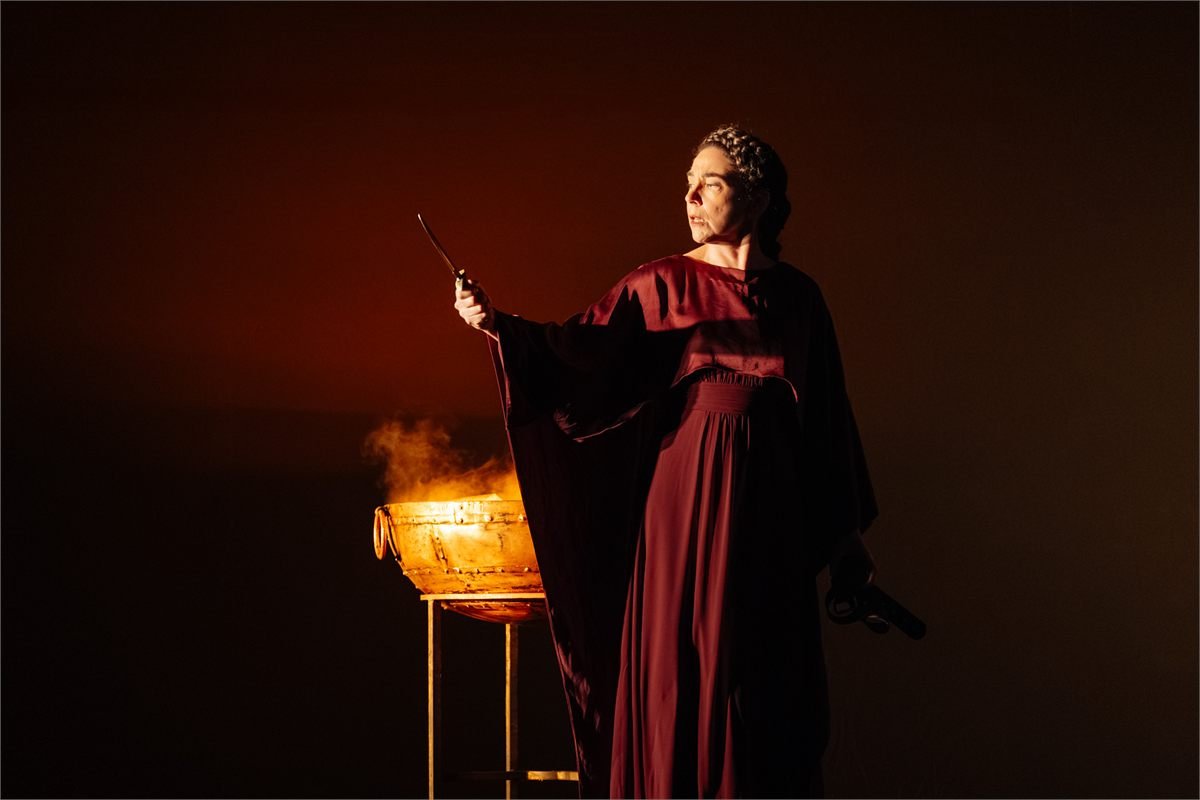 Iphigénie en Tauride at London Coliseum. Photo by Helen Murray
For this new production, the creative team at English National Opera have reverted to Nicolas-François Guillard’s original French libretto which itself was based on Euripides’ play “Iphigenia among the Taurians”.
Oreste (Jacques Imbrailo) and Pylade (Nick Pritchard), cousins and bonded companions often described as ‘two souls in one body’, (though here they could as easily pass for gay lovers), have been chased across the lands by The Furies following their killing of Clytemnestra. In his mind, Orestes believed his mother had it coming in revenge for her murder of his father King Agamemnon. Some would agree. After all, the King sacrificed his daughter Iphigénie (Christine Rice) to the goddess Diana (aka Artemis) in exchange for a fair wind before his fleet could embark to retrieve Helen. The Greeks loved a convoluted plot with twists, turns, and revelations aplenty and “The Odyssey” provides the basis for everything anyone could ever crave. What the characters in this piece do not know, is that at her moment of death, Iphigénie was transported by the playful Goddess to her temple at Tauris, where she has served ever since as High Priestess.
The opera picks-up the story many years later, when following a storm, Iphigénie’s long-lamented brother Orestes and his faithful companion are washed-up on the shore and immediately put in chains by the thuggish ruler King Thoas (Morgan Pearse) according to local custom, after which they will be sacrificed. Secretly, Iphigénie decides she will spare one of them on condition they take a message to her home land Mycenae. But which of the men will go free, and which will die? More importantly, will Iphigénie recognise her brother before any blood-letting?
Director Lyndsey Turner, perhaps mindful of the need to present prominent surtitles above the playing area, has worked with designer Soutra Gilmour to contain the action in a low-level letterboxed set. This was perfectly fine for those of us in the stalls, but I wondered about sightlines for those patrons sitting higher up. Tim Mitchell’s cross-lighting and cone arcs manage to circumvent any restricted illumination issues associated with such a format, but it didn’t stop theatre gremlins (or was it the Gods?) causing a near black-out during the second scene in which King Thoas rails and rants. Thankfully the ever dependable ladies of the chorus, draped in their maroon finery, managed to find lights - including an orange illuminated incense cauldron which captured every wince and grimace during proceedings.
Under the assured baton of Baroque specialist David Bates (making his ENO debut) the orchestra delivered the fast-moving emotional peaks and troughs of Gluck’s work, with aplomb. Most onstage performers too enjoyed a night of clarity and fluidity of phrasing (aside from one notable cracked note). The scene-stealer award of the evening goes to the young performer who assumes the guise of Iphigénie as a child then reveals herself (deus ex machina) as the Goddess Diana (the part will be alternated by Lucy Barton and Zoe Houghton during the run). In the finale Act IV, scene 6, she delivers a breathily beautiful rendering of the recitative “Arrêtez! Écoutez mes décrets éternels” which on opening night was near-perfection.
Latest News
 Review: IPHIGÉNIE EN TAURIDE at London Coliseum
7 November 2026 at 11:55
 PHANTOM OF THE OPERA announces extension and new cast
6 November 2026 at 16:22
 Matt Willis will reprise his role in CABARET
6 November 2026 at 16:09
 BUENA VISTA SOCIAL CLUB to transfer to London in 2027
6 November 2026 at 16:01