
First Look: JANE EYRE at Southwark Playhouse Elephant
Adapting any of the Brontes can be hit and miss, with directors sometimes sacrificing complexity in favour of romanticisation - just look at the recent film adaptation of Emily Bronte's Wuthering Heights. Luckily, this musical adaptation of Charlotte Bronte's Jane Eyre, created by John Caird and Paul Gordon in 1996 and finally brought to the UK thirty years later, manages to capture the tone of the novel while also evoking its Gothic atmosphere and putting the love story at the forefront.
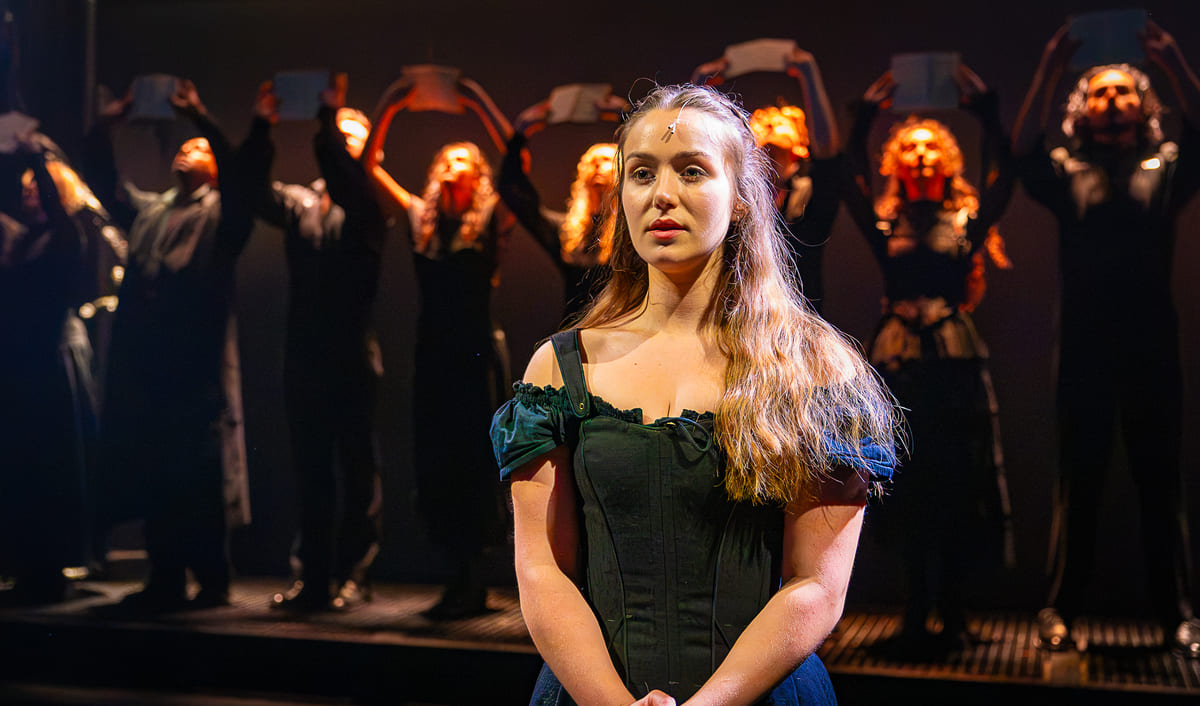 Charlie Burn in Jane Eyre. Photo by Victoria Davies
Please note: Jane Eyre is still in previews at Southwark Playhouse Elephant and does not officially open until Tuesday 8 September 2026. This piece is a first look at the production during its preview period, when the creative team may still be making changes, rather than a review of the finished production.
The orphaned Jane Eyre longs for independence and freedom after a childhood filled with cruelty and neglect. She takes a job as a governess at the beautiful but eerie Thornwood Hall - a place where mysterious laughter in the night can cause unexplained fires. There, she finds herself drawn to its enigmatic and tormented owner, Edward Rochester, but the secrets in his past may destroy everything that’s growing between them.
What makes the production feel so much larger than life than it actually is is its truly phenomenal cast. Charlie Burn, in particular, shines as Jane, with an incredible vocal range that packs just the right depth of emotion into every note. She captures the nuances of Bronte's most beloved heroine with a superb mastery of her micro-expressions, conveying all the subtle moments of restrained disdain, amusement, and mischief to perfection. Ashley Gilmour as Rochester is equally compelling, shifting seamlessly between sardonic humour and deep-seated bitterness that evokes both the brooding Gothic hero but also the very real man behind the mask. The pair have undeniable chemistry, whether they're bantering or sharing a tender moment.
But the real show-stealer has to be Emily-Rose Samuel, the child actress who played the young Jane, as well as Adele, during the performance I attended. Along with an astounding vocal talent, she imbues the younger version of Jane with an irresistible defiance and endearing quality that make her entirely believable as a child version of Burn's Jane. Her Adele is whimsical and charming, with an adorable French accent, and she manages to make the two feel like distinct characters while simultaneously allowing the parallels between the orphaned Jane and the motherless Adele to shine through.
The rest of the cast is equally talented - special mention goes to Eve Shanu-Wilson as the delightfully haughty Blanche Ingram, and Isabelle Methven as Jane’s sweet-natured childhood friend Helen Burns, who’s responsible for some of the most tear-jerking moments in the musical. The whole company gets plenty of room to shine, acting as a chorus that supports Jane in narrating the story. This initially feels a bit jarring and discordant, but once you get used to it, the presence of multiple narrators lends the musical a lyrical, epic quality.
Morgan Large's set design is minimalist, with a largely bare stage, and the production relies on our imagination and the lush, descriptive narration and lyrics, with lines often lifted directly from the novel, to paint a picture and evoke the atmosphere of the eerie, windswept Yorkshire moors and the grand Thornton Hall. There's also a screen behind the stage that projects grainy, black and white images of the countryside and the darkened hallways of the house. The colour palette is monochromatic, with the cast primarily dressed in black, with the occasional white apron or veil thrown on as a scene demands it. The absence of colour feels charmingly Gothic and almost ethereal, as though the story exists outside of time.
And yet it never feels static or visually stagnated. The ensemble performs choreographed numbers that play out the story's more physical scenes and bring certain visual elements to life, like miming Rochester riding a horse down a moonlit road. While narrating, the chorus weaves through the principal action of the play, existing both outside it and as a part of it. It creates a strong sense of dynamism, and allows the otherwise barren stage to come alive.
The musical numbers are short and not overly memorable (there are a lot of wails of "Jane" during dramatic moments), but they are lyrically evocative and poetic, sometimes incorporating lines from Bronte's writing. Larry Hochman’s complex orchestrations add an epic, almost cinematic quality to the score. Along with Bertha Mason's eerie harmonisations, the overall effect is haunting and dream-like. Also particularly effective are the counterpoint duets that show two characters onstage at odds with one another or exploring the same themes from different angles, whether it's Rochester and Jane reconciling their feelings for each other or Jane and Blanche expressing their vastly different feelings towards Thornwood Hall.
As an adaption, but musical condenses the story where needed but retains a cohesive flow of storytelling. It also strikes a balance between Jane and Rochester's love story, which is the emotional core of the plot, and Jane's own character arc as she yearns for freedom and independence, without sacrificing one in favour of the other. In the novel, Jane is constantly addressing the reader directly ("reader, I married him," being one of the most famous quotes in literature), and this is mirrored in the narrative device the musical employs. Both Jane and the ensemble narrate her inner-most thoughts to the audience, and the older Jane stands on the sidelines and observes her younger self as the opening scenes retell her childhood, watching her own life unfold before stepping into the story and replacing the young Jane. The overall effect serves to centre Jane herself as the heart of the musical, and, particularly within the small space of the theatre, creates an intimate performance that's evocative of the novel's confiding, memoir-like tone.
There are some aspects where the musical doesn't quite work as well from an adaptation standpoint, either straying from the source material or too conscious of its modern audience. Its core message of being "brave enough for love", expressed in the final musical number, feels a tiny bit more moralising than Bronte's novel, which is preoccupied with a woman's search for identity and personal freedom outside the bounds of social barriers. The musical also sidesteps some of the uncomfortable implications around Bertha Mason, who has regularly been assumed to be a woman of colour by many literary scholars, by casting a white actress (Hannah Lindsey) in the role - though ironically, her brother Richard Mason is played by a black actor (Jonathan Andrew Hume), muddying the waters slightly around what the production was trying to imply.
Regardless, where the musical succeeds is in capturing the spirit of Bronte's novel through its aesthetics, musical style, and the cast's portrayal of its often complex characters. What emerges is something quite lovely: hauntingly beautiful in places, emotionally devastating in others.
Latest News
 Review: ILFORD BOY at Donmar Warehouse
23 October 2026 at 12:59
Review: ILFORD BOY at Donmar Warehouse
23 October 2026 at 12:59
 Review: DERREN BROWN: ONLY HUMAN at Apollo Theatre
22 October 2026 at 23:00
Review: DERREN BROWN: ONLY HUMAN at Apollo Theatre
22 October 2026 at 23:00
 Secret Cinema announces initial casting for DISNEY'S PIRATES OF THE CARIBBEAN: THE IMMERSIVE ADVENTURE
22 October 2026 at 14:48
Secret Cinema announces initial casting for DISNEY'S PIRATES OF THE CARIBBEAN: THE IMMERSIVE ADVENTURE
22 October 2026 at 14:48
 THE MOUSETRAP celebrates 75th anniversary with new cast, director, and redesign
22 October 2026 at 14:24
THE MOUSETRAP celebrates 75th anniversary with new cast, director, and redesign
22 October 2026 at 14:24