
Review: TAO OF GLASS at Soho Place Theatre

Just outside Tottenham Court Road Station, in the heart of London's West End, @sohoplace remains one of the capital's boldest theatrical spaces. London's first purpose-built theatre in the round for half a century, the stage is reminiscent of the Globe and invites audiences on various balcony levels to lean over the ledge and into the action.
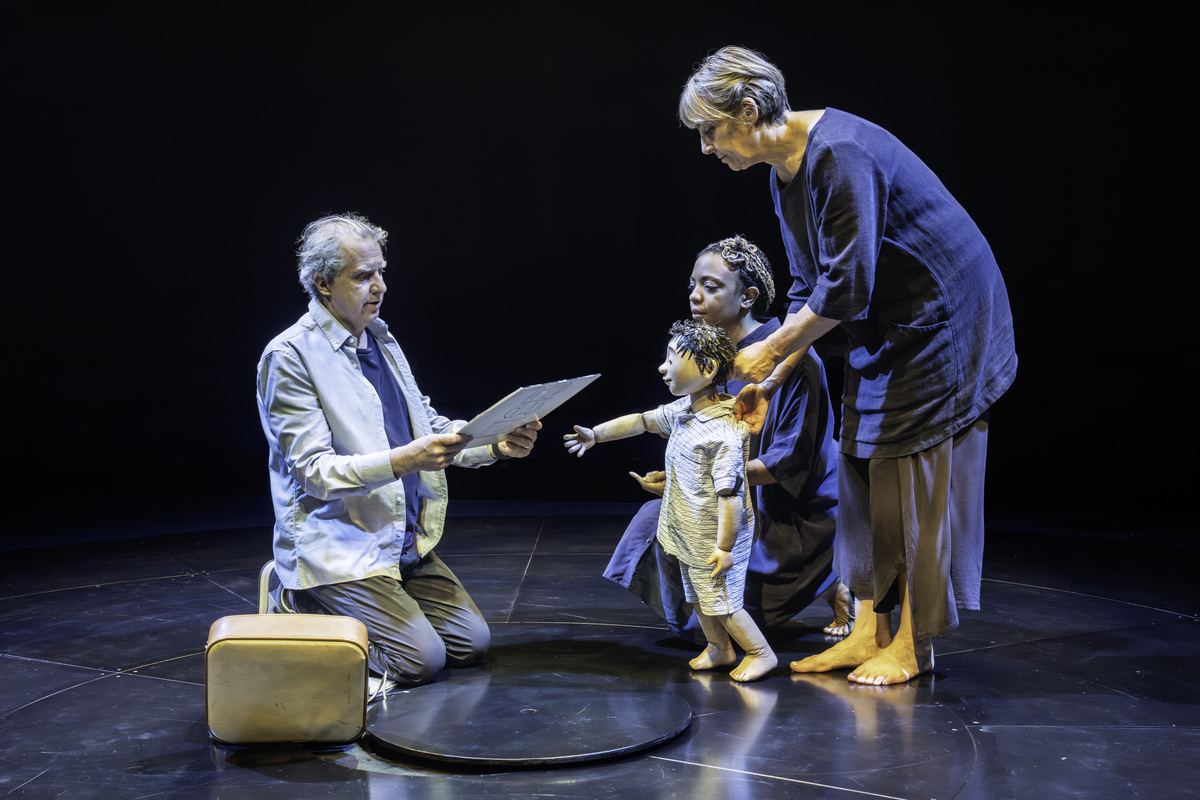 Photo by Johan Persson
It is perfectly suited to experimental work and Tao of Glass feels as though it belongs nowhere else. As the audience filters into the intimate circular auditorium for the 7.30pm performance, conversation buzzes around the room. Then silence. A spotlight falls not on the stage but on an apparently ordinary man sitting in the front row. Casual clothes, just beyond middle age, white hair thinning at the crown. The audience laughs awkwardly because surely this is a mistake? He begins talking to the woman beside him who giggles nervously. Why hasn't someone switched the light off? Gradually he addresses everyone and we realise this is the start of the performance. Very self-reflective, it is one of the most entertaining theatrical openings I have seen in recent years. The man is Phelim McDermott playing a version of himself. He admits that he never quite knows how to begin a play or what to do with this liminal moment before theatre fully begins. He actually relishes the awkwardness of theatre etiquette, loves the anticipation, the excitement and how everyone shuffles around to get ready for what they are about to experience. But most of all he just loves the wonder of theatre and how it has the power to enliven, to transform, to create magic. He talks about growing up in Manchester, his formative experiences of theatre and what led him to become a performer-director. He meditates on how he grew up seeing actors such as Ben Kingsley and Helen Mirren on stage and dreamt of becoming a great Shakespearean actor himself.
In this opening McDermott describes Tao of Glass as ‘the story of a play that almost didn't happen’. It is part memoir, part theatrical essay, part concert and part meditation on the music of the American composer and pianist Philip Glass, whose work has accompanied McDermott throughout his artistic life. Rather than presenting a conventional biography of Glass, McDermott tells stories from his own life, that each have some sort of connection to the composer. He recalls his discovery of Glass’ album ‘Glassworks’ as a young man in Manchester and how he would listen to it on full volume alone in his room, much to the confusion and sometimes annoyance of his family. His first theatrical production would be an adaptation of ‘The Covered Man’ by Ian McEwan, told against the backdrop of Glassworks’ opening track. Later, he would be asked to adapt a production of Maurice Sendak’s ‘In The Night Kitchen’ accompanied by Glass’ music. His monologues tell of how some of these projects succeeded, whilst others failed and alongside this he also shares a few seemingly insignificant memories. Indeed, not all of what he shares has an obvious connection to Glass, rather they can sometimes be delightfully tenuous - for example the story of how an expensive glass coffee table was shattered by builders. Perhaps the connection here really is just…glass? Perhaps these links are deliberately flimsy and that is the point.
Ultimately, I believe, the play is less about Philip Glass than about what it feels like to encounter genius. If this is the case then McDermott becomes our guide and we are exploring the work of an artistic genius through the lens of the ‘everyman’, showing how another artist's work can quietly shape an ordinary life. Through McDermott’s eyes, Glass becomes both an icon and an intensely human presence. It would be easy for such a personal piece to become self-indulgent but this is countered by McDermott's warmth and awkward charm which, by contrast, make him remarkably relatable. His enthusiasm and fascination is infectious, as is his palpable love of theatre and music which permeates through the audience.
This production originated at Manchester International Festival before transferring to sohoplace and it really demonstrates extraordinary theatrical craftsmanship. Co-directed by Kirsty Housley and McDermott himself, it continually reminds us that theatre can create entire worlds from almost nothing. Designer Fly Davis provides a stage that appears deceptively simple and yet almost every object present transforms before our eyes. Three performers accompany McDermott throughout the production, each dressed head to toe in conspicuous black: Janet Etuk, Sarah Wright and Vic Llewellyn. They serve simultaneously as actors, puppeteers and stagehands, gliding almost invisibly around the stage as they manipulate props, shift scenery and conjure remarkable visual effects. Their work is so seamless that they seem to disappear into the fabric of the production, only drawing attention to themselves at the precise moment they are needed. Alongside the performers appears a puppet of the child protagonist from Maurice Sendak's In the Night Kitchen, while an assortment of everyday household objects is continually transformed into fantastical characters and landscapes. One of the production's most memorable sequences stems from McDermott's recollection of ‘Billy's Wonderful Kettle’, a play he was too ill to see as a child and has spent a lifetime mourning and imagining. He jokes that ever since, every production he attends is measured against the mythical brilliance of ‘Billy's Wonderful Kettle’. Describing it as a kind of ‘Mancunian Aladdin’, the story is brought vividly to life when an ordinary kettle becomes the head of an enormous genie, its body fashioned from crumpled sheets of tissue paper. These seemingly modest materials are endlessly reinvented. Tissue paper, printed with fragments of musical scores, transforms into cloaks, hats, Glass’ famous flowing hair that bobs as he plays the piano, costumes and entire landscapes. The hollowed interior of a piano becomes a shadow theatre, while humble kitchen utensils combine to evoke the illuminated skyline of New York. Lengths of tape stretch across the stage, physically connecting people and objects in much the same way that Glass's music binds together McDermott's memories. Throughout, the production demonstrates an astonishing ability to create rich theatrical worlds from the simplest of materials, making the ordinary appear quietly magical.
Each and every transformation feels playful yet profoundly imaginative. Watching these images appear is like watching Philip Glass's music itself, as these minimal materials generate enormous emotional worlds. The tissue paper becomes a visual metaphor for Glass's compositions: apparently simple elements that accumulate into something unexpectedly vast and have the capacity to capture and create entire worlds. Likewise, it reminds us of the power of our imagination to bring things to life, the make the ordinary extraordinary, to find inspiration and fascination all around us. Lighting designer Colin Grenfell and sound designer Giles Thomas ensure that every transition feels fluid, while puppet designer Lyndie Wright contributes some of the production's most memorable theatrical illusions. Under the direction of percussionist Chris Vatalaro and pianist Katherine Tinker; the onstage ensemble include Tinker and Vatalaro, Kasia Ziminska (violin), Jack McNeill (clarinet), Daniel Bradley and Simon Roth (percussion), who perform Philip Glass's music with remarkable sensitivity. Sometimes the musicians occupy the stage; sometimes they disappear into the darkness, allowing the music to drift almost subconsciously through the theatre, which means that Glass’s compositions are never simply accompaniment but rather serve as the architectural structure that holds this play together with strength and force.
Just like McDermott recalled listening to Glassworks repeatedly in his bedroom as a young man, escaping into its hypnotic rhythms, throughout the evening the music performs precisely the same function for the audience. It transports us into the landscapes of his imagination so that, by the end, everything circles back to where it began. Recounting a moment from his time working alongside Glass in the studio, McDermott lies quietly on the floor as the piano plays Glass’ work. He is describing to Glass an exercise in which one pretends to be in a coma in order to become completely present in the moment. He invites Philip Glass to ‘meet him there’ emotionally, mentally and spiritually. The scene lasts longer than expected and risks becoming indulgent but instead it becomes strangely moving. We are invited to lose ourselves, just like McDermott in this moment, to meet him there with the music. To tap out of the chaos of everyday life and sit still, listening to the calm world-building mastery of Glass’ music. Eventually McDermott produces a record player and places Glassworks on it. As the final movement begins, the live musicians gradually join the recording until recorded sound and live performance become indistinguishable. It is a beautiful full-circle ending which returns us to its opening meditation on theatre and music: their power to transform, to imagine, to build entire worlds from the smallest of materials.
Tao of Glass is ostensibly about Philip Glass, but in truth it is about what great art does to ordinary people. It explores memory, creativity, admiration and the quiet moments that shape a life. McDermott's stories may occasionally feel slight in themselves, but together they accumulate, much like Glass's music, into something unexpectedly profound. The production reminds us that theatre does not require elaborate spectacle to be magical. With tissue paper, tape, kitchen utensils, puppetry, music and extraordinary imagination, it creates spectacularly artistic and stylistic images that linger long after the performance has ended. Ultimately, Tao of Glass is a celebration of the transformative power of theatre and music. It shows how one person's memories can become a shared world, inviting an audience not simply to observe, but to enter it. Like Philip Glass's music itself, it finds beauty in repetition, simplicity and presence, proving that theatre can still make something extraordinary out of almost nothing.
Latest News
 Production photos released of Christine Baranski and Richard E Grant in HAY FEVER
28 September 2026 at 17:58
Production photos released of Christine Baranski and Richard E Grant in HAY FEVER
28 September 2026 at 17:58
 Winners announced for the 2026 Stage Debut Awards
28 September 2026 at 13:42
Winners announced for the 2026 Stage Debut Awards
28 September 2026 at 13:42
 10 Best New Theatre Openings in October 2026
25 September 2026 at 14:00
10 Best New Theatre Openings in October 2026
25 September 2026 at 14:00
 Review: THE URMETAZOAN at Hampstead Theatre
25 September 2026 at 11:09
Review: THE URMETAZOAN at Hampstead Theatre
25 September 2026 at 11:09