
Review: FENCES at Lyric Hammersmith
August Wilson’s FENCES is one of a handful of truly great, late 20th century plays, due to its ability to effortlessly capture and convey the bitter disappointment which underpins The American Dream. In particular, it is noteworthy for recognising the repercussions on individuals and families when opportunity is denied to a whole strata of society.
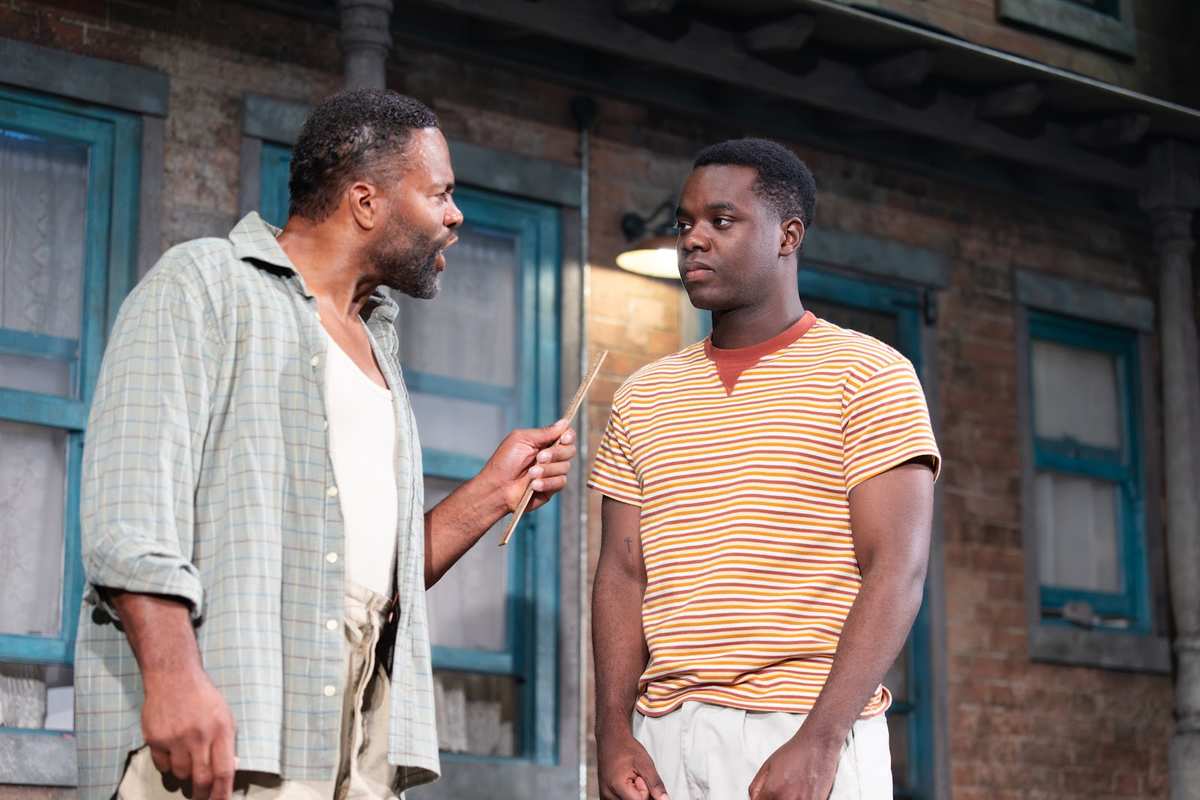 Fences at Lyric Hammersmith. Photo by Tyler Fayose
With a backdrop of change, a burgeoning civil rights movement and an increasingly unionised workforce, the play is set in 1957 Pittsburgh. Through a mixture of respect and intimidation, former Negro League baseball player Troy Maxson (a powerful Ray Fearon) has raised two sons. First of these is a struggling sax player Lyons (Michael Ahomka-Lindsay) whose infrequent visits coincide with his father’s weekly pay packet and requests to borrow $10. Then there’s Cory (Josh Tedeku) a strapping lad who is still at school and works part-time at the A&P store but whose true calling is to become an American Football player.
News that Cory is about to be scouted, plays badly with his father who is mistrusting of sports promoters due to his belief he was passed over for the Major Leagues because of his race rather than his age. Anchoring the household’s testosterone, is Troy’s loving and churchgoing wife Rose (a wonderfully measured Madeline Appiah) with whom he has been married for 18 years. Of late however, close friend and work colleague Jim Bono (Everal A Walsh) has noted Troy’s interest in a new woman to the neighbourhood, and counsels caution. Her arrival disrupts the play’s familiar and comedic tones, proving a catalyst for its descent into combativeness and pain.
Underpinning much of the dialogue and later fractiousness is a desire to show the longer-term damage which violent and bullying parenting can cause. Troy views the relationship with his sons as one of duty and responsibility. His need to dominate coupled with an overriding demand for respect (whether earned or otherwise) is neatly balanced against Rose’s motherly self-sacrifice and unconditional love. The fence too provides the play’s central conflicting metaphor for protection (against Death whom Troy dreams of battling) but equally the prison in which the lives of others become contained and controlled. Occasionally dropping into the action is Troy’s war-injured brother Gabriel (Simon-Anthony Rhoden) who, trumpet in hand, serves as the damaged and vulnerable innocent of the past. The innocence of the future takes the form of a loved baby daughter Raynell (an adorable turn from Aita Mushuku on opening night but the role will be played by 5 others during the run) who heralds a return to a calmer and more playful future for the troubled household.
Set and costume designer Lily Arnold has utilised a largely static rear porch for the first half, with the house and backyard fenced-in to create an almost cosy ambience for the chatty and playful exchanges. Later as the play moves into its destabilised phase, the house turns on its central revolve revealing the interior.
Directed by Daniel Bailey for Headlong, the production is one of the stronger examples of regional theatre collaboration having first opened at Leeds Playhouse with a short future stint also planned at HOME Manchester. The run at Lyric Hammersmith continues until 31st October and plays 3 hours including interval.
Latest News
 Review: FENCES at Lyric Hammersmith
10 October 2026 at 13:08
Review: FENCES at Lyric Hammersmith
10 October 2026 at 13:08
 Rehearsal photos released for THE DEVIL WEARS PRADA
9 October 2026 at 13:17
Rehearsal photos released for THE DEVIL WEARS PRADA
9 October 2026 at 13:17
 Review Roundup: RENT at the Tom Stoppard Theatre
9 October 2026 at 10:20
Review Roundup: RENT at the Tom Stoppard Theatre
9 October 2026 at 10:20
 Rehearsal photos released of the new cast of THE HUNGER GAMES: ON STAGE
9 October 2026 at 10:03
Rehearsal photos released of the new cast of THE HUNGER GAMES: ON STAGE
9 October 2026 at 10:03