
Review: I MADE YOU A MIXTAPE at the Cockpit Theatre

What is the recipe for a Fringe play? Not necessarily a successful one, but any Fringe production, whether in Edinburgh, London or elsewhere. First, you need the means: a company, complete with cast, crew, technical team and a collective vision to get a show on the road. Then you need time. Putting on a production is a huge commitment and not one easily accommodated around a standard nine-to-five job. Rehearsals, get-ins, tech runs - people need to be available at the drop of a hat. You need a supportive venue with organisers willing to back the work. Finally, you need supporters: audiences willing to attend and people willing to contribute financially, whether from within the company or beyond it.
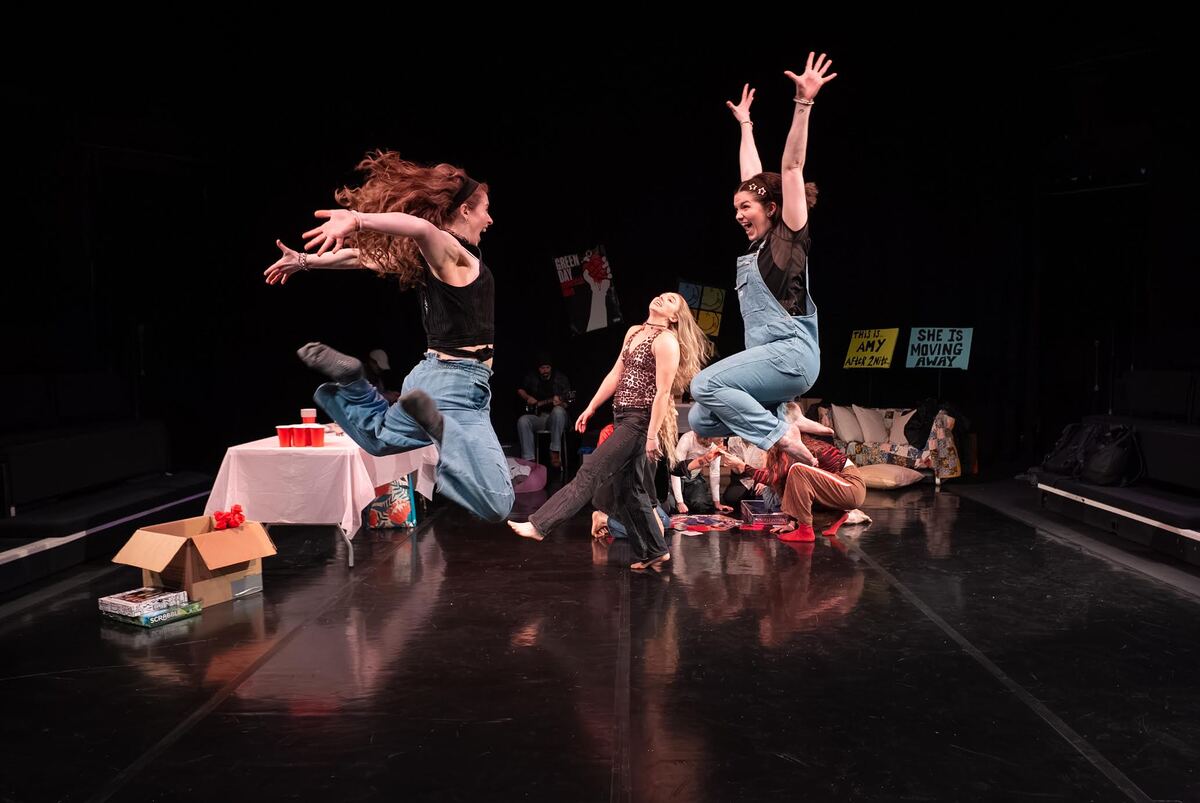 Photo provided by production
Response Theatre Company has certainly ticked all of those boxes. Indeed, much of the audience appeared to know someone involved in the production, which served to generate an enthusiastic atmosphere from the onset. The company is also supported by the Canada Council for the Arts, no small endorsement. But there is one ingredient I have omitted because I'm no longer sure it is considered essential. Or perhaps recent experiences have made me question its importance. That ingredient is: ‘something to say’.
Fringe theatre, by its very nature, exists to showcase new voices and perspectives. It gives space to stories and experiences that might otherwise go unheard. Sometimes Fringe productions attempt to say too much within a limited running time, sometimes their ambitions outstrip the attention span of a drunk, late-night audience, exhausted by a day of theatre-going. In the case of I Made You a Mixtape, however, I found myself wondering whether enough was being said at all.
The premise is straightforward. In fact, the production is keen to establish that it is not really a play. This is announced almost immediately through one of several neon cue cards that appear throughout the performance. It is not quite theatre, nor is it musical theatre. The show places us at a college dorm party in the 1990s, presumably somewhere in North America, given the cultural references and soundtrack. Two musicians sit at the back of the stage, one on guitar and one on drums, looking very 90s with their long shaggy hair and accompanying a succession of well-known 90s songs. There is no dialogue. Instead, these cue cards introduce the characters and provide snippets of information about their futures, e.g. ‘This is so-and-so. Tomorrow she is quitting school’ and so on. The rest of the performance unfolds through movement.
In some ways, it resembles Andrew Lloyd Webber’s Cats. Each character receives an introduction through a song that encapsulates something about their personality or where they’re at at this moment in their lives. The character quitting school, for instance, is paired with Alanis Morissette's ‘You Oughta Know’. Through these songs, we are invited to piece together the emotional landscape of a single evening and the relationships that exist within this group of friends. The challenge is that we never really get beyond these introductions, we learn little else about the characters and even their relationships to one another remain frustratingly vague.
The movement itself initially confused me. Calling it dance feels misleading. There is rhythm and choreography, certainly, but much of what we see resembles embodied movement or ecstatic dance rather than technically demanding performance. The cast roll around, sway, gesture and physically express themselves more than they execute recognisable dance moves or sequences. Only later when researching the play did I discover the company's use of the Meisner technique and movement-based storytelling. Knowing this retrospectively helped contextualise what I had seen. The performance becomes less about dance and more about emotional release. This is the last party these friends will share together; the mixtape, a quintessentially 90s gesture, becomes a vehicle for nostalgia, farewell and collective memory. Yet even with this context, I struggled to identify precisely what the show wanted to communicate.
Perhaps the point is simply the atmosphere or capturing the joy of a specific moment in time. Perhaps the whole thing is a celebration of pre-social-media youth, when people expressed themselves through things like making and sharing mixtapes to show other people how they feel and lived more fully in the present. If so, the production succeeds in many respects. The world-building is meticulous. Oasis and other 90s hits play as the audience enters. Posters, magazine cut-outs, a bean-bag sofa, beer pong, a Friends jigsaw, Twister - every detail contributes to a carefully curated sense of nostalgia. Even the costumes and hairstyles, complete with scrunchies, feel lovingly observed and the company's affection for the decade is undeniable.
The synchronised sequences are definitely more effective than the solos in my opinion. They felt better suited to capture the collective energy of a party and the exhilaration of sharing a moment with others. These are the points at which the performance feels most alive, that being said, some of the solo sections are also genuinely evocative. However, movement-led storytelling has its limitations. Emotional moments are often conveyed in the same way i.e. through prolonged eye contact. But subtle gestures like this can easily be lost in a theatre setting. Theatre often demands a degree of exaggeration, especially if emotional information is to be communicated to the audience clearly. Here, the subtleties often remain just that: subtle.
The production also risks feeling like an insider's experience. One of its taglines is 'the party you wish you were invited to.’ Indeed, throughout the performance, I didn’t feel like I was - I felt very much excluded. The cast inhabit a world entirely their own and because we are given so little insight into their relationships or experiences, we remain outside observers looking in. There is a fine line between sharing joy and asking an audience to watch other people have fun. Bringing one audience member onstage or going around the theatre offering the audience crisps does not, I feel, constitute as enough to make them feel included. If the intention is to make us participants then the invitation needs to be more meaningful. If the intention is simply observation then the production needs to offer something deeper for us to connect with. So my question remains: why are we watching?
I should also acknowledge an aspect that I heard audience members discuss afterwards. The cast is self-described as ‘nine girls’ and there is little visible diversity within either the company or the musical selections. Given that the production is so invested in nostalgia, it inevitably raises questions about which version of the 1990s is being remembered and celebrated. What memories are being foregrounded and which are absent? That may not be the show's intention, but the absence becomes noticeable precisely because the production offers so little explicit commentary of its own.
On the whole, however, there is a bit to admire here. The soundtrack is crowd-pleasing, the company’s enthusiasm for the 90s is infectious and the commitment of the performers unquestionable. The production definitely avoids the dourness that can characterise some Fringe work and instead embraces joy, sentimentality and a sense of communal energy (albeit only amongst those on stage). But joy alone is not always enough. If I Made You a Mixtape wants us to join the party, it needs to do more than recreate it. We were not there the first time. We do not know these people. We do not share their memories. Beyond enjoying the music and appreciating the nostalgia, we need something to hold onto ourselves. Something like a clearer message, stronger character connections, a reason to care. Otherwise, we are left watching a group of people relive a moment that belongs to them rather than one that has been shared with us.
Latest News
 Review: GOLDEN BOY at Almeida Theatre
16 September 2026 at 00:05
Review: GOLDEN BOY at Almeida Theatre
16 September 2026 at 00:05
 Cast announced for one-part production of HARRY POTTER AND THE CURSED CHILD
15 September 2026 at 11:54
Cast announced for one-part production of HARRY POTTER AND THE CURSED CHILD
15 September 2026 at 11:54
 LEGALLY BLONDE to transfer to the West End with Amber Davies reprising her role
15 September 2026 at 10:58
LEGALLY BLONDE to transfer to the West End with Amber Davies reprising her role
15 September 2026 at 10:58
 Family Shows to Watch in London this Year
15 September 2026 at 10:54
Family Shows to Watch in London this Year
15 September 2026 at 10:54