
Review: JO - THE LITTLE WOMEN MUSICAL at Theatre Royal Drury Lane

Louisa May Alcott’s original story of the four March sisters - Meg, Jo, Beth and Amy - and their transition from playful girls into womanhood, has been the subject of countless adaptations, including four major film studio productions (excluding earlier silent reels), going back as far as George Cukor’s 1933 classic starring Katharine Hepburn. On Sunday 25th January, patrons of the Theatre Royal Drury Lane were treated to the world premiere, semi-staged, concert version of the inevitable stage musical.
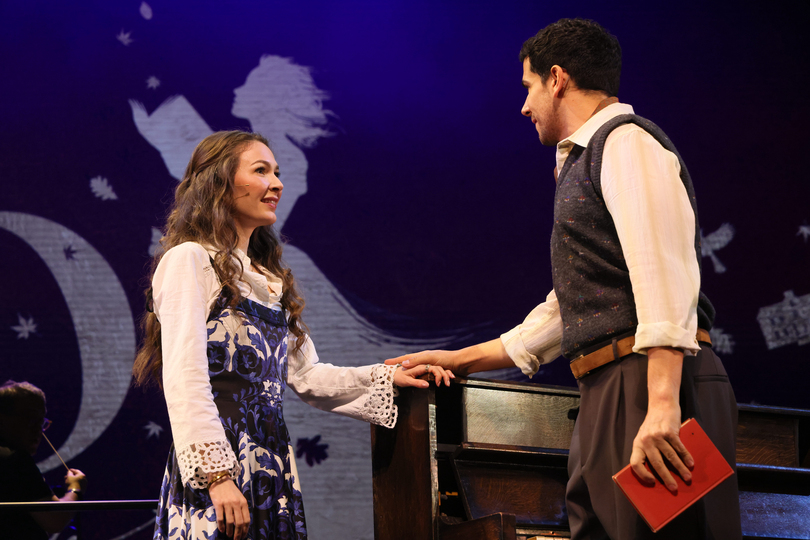 Jo - The Little Women Musical production image. Photo by Roger Alacorn
With book and lyrics by Christina Harding and John Gabriel Koladziej, and fully orchestrated music by Dan Redfeld, nothing was left to chance, with the man himself conducting his near 30-strong onstage musicians, supplemented by a further dozen chorus singers ranged either side of the orchestra. With a mere 10minute hiatus in getting underway, the stage was set for the principals to deliver the familiar familial tale set during, and immediately after, the American Civil War.
The first thing to note is that this is a musical that, from a stylistic perspective, leans heavily into the Disney sound. Each of the sisters —particularly Jo played with vibrancy and gusto by Christina Allado — has been chosen for a vocal timbre which resonates with the romanticised orchestrations which flooded the huge auditorium. Even allowing for some undesirable yet understandable missed head-mic cues (given the one-night nature of a busy show), the massive space was awash with strings and French horns and lushly swirling underscoring, which at times was redolent of a Rodgers and Hammerstein musical. There will always be moments when a keen ear is able to isolate a minor refrain from another show — be it Phantom, Les Mis, Jekyll and Hyde or indeed South Pacific — but in the main, the songs were strongly and individually written and showed great potential. What a pity then, that there were SO VERY MANY of them, when less would definitely be more. Hopefully, the creative team will eventually conclude that the culling of three or four superfluous filler tunes will better serve the narrative structure and reduce some of the flabbier excesses which resulted in a near 3 hour running time, including interval.
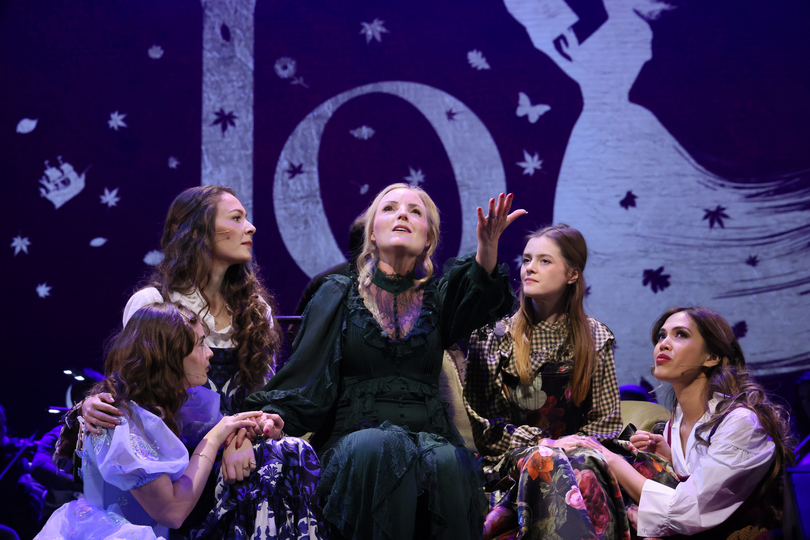 Jo - The Little Women Musical production image. Photo by Roger Alacorn
As the artist of the family, Amy (a wonderful turn by newcomer Sophie Pollono) chaperones her aged and wealthy Aunt March (Tracie Bennett milking her gloriously amusing, stock-in-trade, crusty old broad routine) to France, as indicated by a couple of parasols and accompanying cod French accents. Here, she paints and is badgered by an unpleasant Brit to test her marriage potential, but eventually leaves with Theo ‘Laurie’ Laurence (delivered with a winning juvenile earnestness by Tobias Turley) the young man who she romanticises earlier in the story when he moves into the house opposite back in Concord, Massachusetts. Other key plot lines, including Father (Julian Ovenden) returning after his illness and Beth (Eleanor Grant) first surviving Scarlet Fever only to later succumb to her sickly disposition, are here. Marmee (Kerry Ellis) oversees her chicks, but is largely underused, which didn’t appear to stop her from expecting a standing ovation on arriving down stage — but it was a concert after all, so the top billed stars should be permitted their affectations. Finally, the eldest sister Meg (played by soprano Kelly Mathieson) seemed to rather disappear, perhaps the strongest indication that as we throw-off childish things, there is a tendency for us to conform as we age. This musical, like Alcott herself, demands that we hold onto our youthful vigour and individuality for as long as possible although recent attempts to right the wrongs insisted upon by the author’s original publishers (they demanded that Alcott had Jo marry) have not been included, so her contrived German love interest Professor Bhaer (Chris Mann delivering another fairly cod accent) still arrives at the train station ready to become the husband Jo apparently needs and craves.
Maybe, just maybe, in later iterations of the musical, she could prove to be an independent girl and remain an independent woman. I think Alcott may have preferred that ending to the one she was forced to write. Just a thought.
Latest News
 Cast announced for one-part production of HARRY POTTER AND THE CURSED CHILD
15 September 2026 at 11:54
Cast announced for one-part production of HARRY POTTER AND THE CURSED CHILD
15 September 2026 at 11:54
 LEGALLY BLONDE to transfer to the West End with Amber Davies reprising her role
15 September 2026 at 10:58
LEGALLY BLONDE to transfer to the West End with Amber Davies reprising her role
15 September 2026 at 10:58
 Family Shows to Watch in London this Year
15 September 2026 at 10:54
Family Shows to Watch in London this Year
15 September 2026 at 10:54
 StarKid's NERDY PRUDES MUST DIE is coming to the West End
15 September 2026 at 09:30
StarKid's NERDY PRUDES MUST DIE is coming to the West End
15 September 2026 at 09:30