
Review: MASS at Donmar Warehouse
Mark Twain supposedly once said “Forgiveness is the fragrance that the violet sheds on the heel that has crushed it”. At a neutral space provided by the kindly folks at an American Episcopalian church, two middle-aged couples meet. It is their chance to better understand why they each lost a son to violence — the result of a school shooting incident. Their situations are strikingly similar, yet profoundly different.
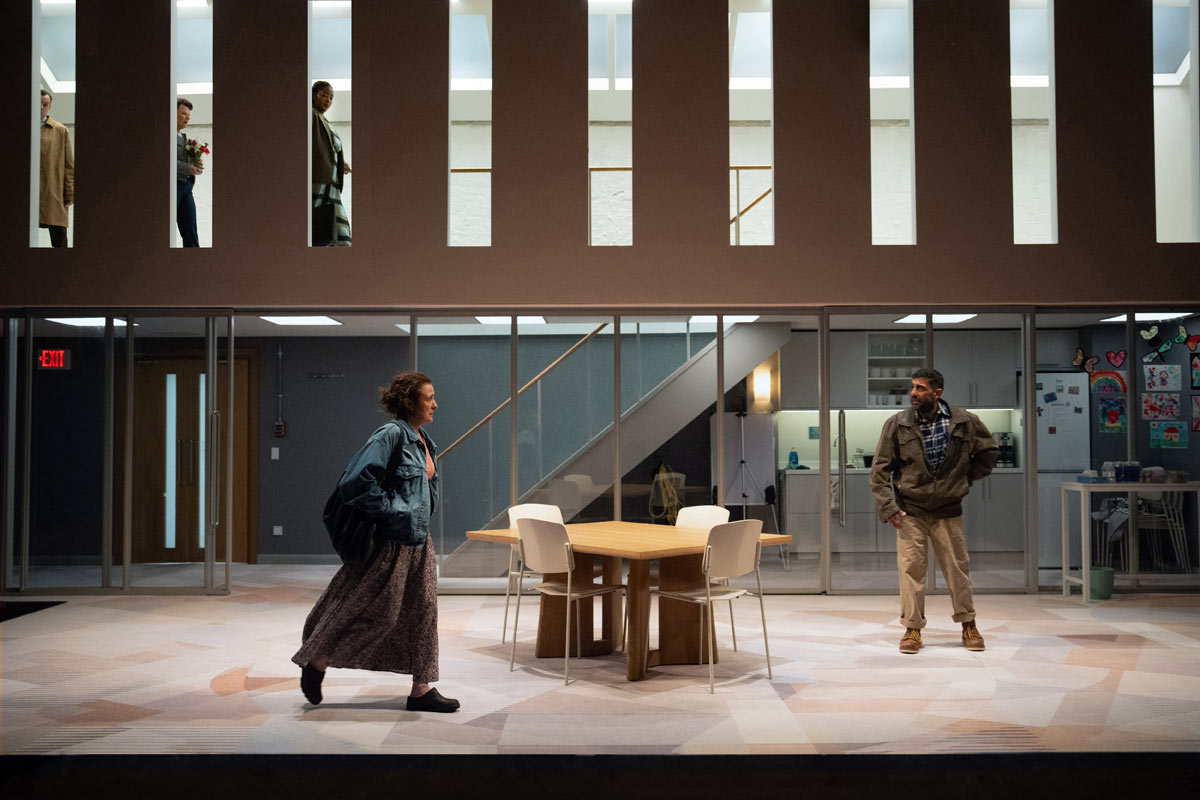 Paul Hilton, Monica Dolan, Rochelle Rose, Lyndsey Marshal, and Adeel Akhtar in MASS at Donmar-Warehouse. Photography by Richard Hubert Smith.
MASS written by renaissance man Fran Kranz starts quite sedately and is imbued throughout with a restrained emotional agony which underpins the performances of each cast member. Brandon (Amari Bacchus) arrives at and makes a tentative effort at clearing up the used mugs and throwing a vacuum around the space. He is joined by Judy (Susie Trayling) who is flustered and running late but being a good Christian, has agreed to provide the space for an undisclosed purpose to people in need. In her eagerness to do the right thing, she has also (inexplicably) shopped for food. What we learn from the calm and measured facilitator of the in-person meeting Kendra (Rochelle Rose) who arrives next, is that it needs to be quiet and undisturbed to be of value to the participants.
As Archbishop Desmond Tutu once observed, “There is no future without forgiveness”. It is a statement at the heart of this compelling and heartrending story of those trying to make sense of, come to terms with, and move on from the meaningless and inexplicable loss of a loved one. When that loved one is a child, the grief feels all the more unjust and subject to universal condemnation.
And so to the arrival of Gail (Lyndsey Marshal) and Jay (Adeel Akhtar) who are on edge but gradually manage to settle themselves before the arrival of besuited Richard (Paul Hilton) and Linda (Monica Dolan) who is bearing a small glass vase of handpicked flowers. The gesture is a conciliatory ice breaker entirely in keeping with the situation, but completely lacking in magnitude or reflective of the gravity of the revelations we are about to learn.
One bullied son has become introspective, playing video games and feeling isolated despite the best efforts of his parents to bring him out of his shell. The other is a quite ordinary and average high school student. The former uses his otherness as a catalyst to create havoc - in this case a pipe bomb and later, the use of guns to shoot and kill pupils in a classroom before killing himself in the library where he felt most at ease.
It is the altogether too familiar story which has been beamed into our living rooms ever since Columbine, which reinforces criticism of the USA's acceptance of ubiquitous firearm possession and stokes the fires of dissent from those who bandy words about amendments, rights and freedoms, while accepting the resultant death tolls of innocents as collateral damage. Here, the wider opposing political ideologies are neatly circumvented. Instead, the piece consciously focuses on personal grief and the need to heal, played against a parent's overriding compunction to demonstrate a determined loyalty to their dead and otherwise unrepresented child.
Under Carrie Cracknell's empathic direction, the table is positioned centre stage on Anna Yates' beautifully realised set design which deploys an almost indiscernibly slow and steady revolve to ensure the audience captures every physical expression and moment of wrought inner torment from the universally excellent ensemble of actors.
It is not an easy watch, but with Guy Hoare's lighting design providing an almost epiphanic final moment as the choir is heard rehearsing next door, this is undoubtedly another triumph for the Donmar.
Latest News
 Review: THE PASS at The Pearly Queen Theatre
18 September 2026 at 23:58
Review: THE PASS at The Pearly Queen Theatre
18 September 2026 at 23:58

 Cast announced for new musical NERO
18 September 2026 at 16:20
Cast announced for new musical NERO
18 September 2026 at 16:20
 Review: MAN TO MAN at Royal Court Theatre
18 September 2026 at 09:16
Review: MAN TO MAN at Royal Court Theatre
18 September 2026 at 09:16
 Megan Hilty and Rachel Tucker to star in concert production of GENTLEMEN PREFER BLONDES
17 September 2026 at 16:46
Megan Hilty and Rachel Tucker to star in concert production of GENTLEMEN PREFER BLONDES
17 September 2026 at 16:46