
Review: CYRANO DE BERGERAC at Noel Coward Theatre
The story of Cyrano de Bergerac has been retold, reimagined, and adapted countless times, continuing to fascinate us even after centuries with its unique twist on the love triangle trope, sense of dramatic irony, and potential for both comedy and tragedy. The RSC's acclaimed production, now playing at the Noel Coward Theatre, adapts the story faithfully but also imbues it with a somewhat modern sensibility.
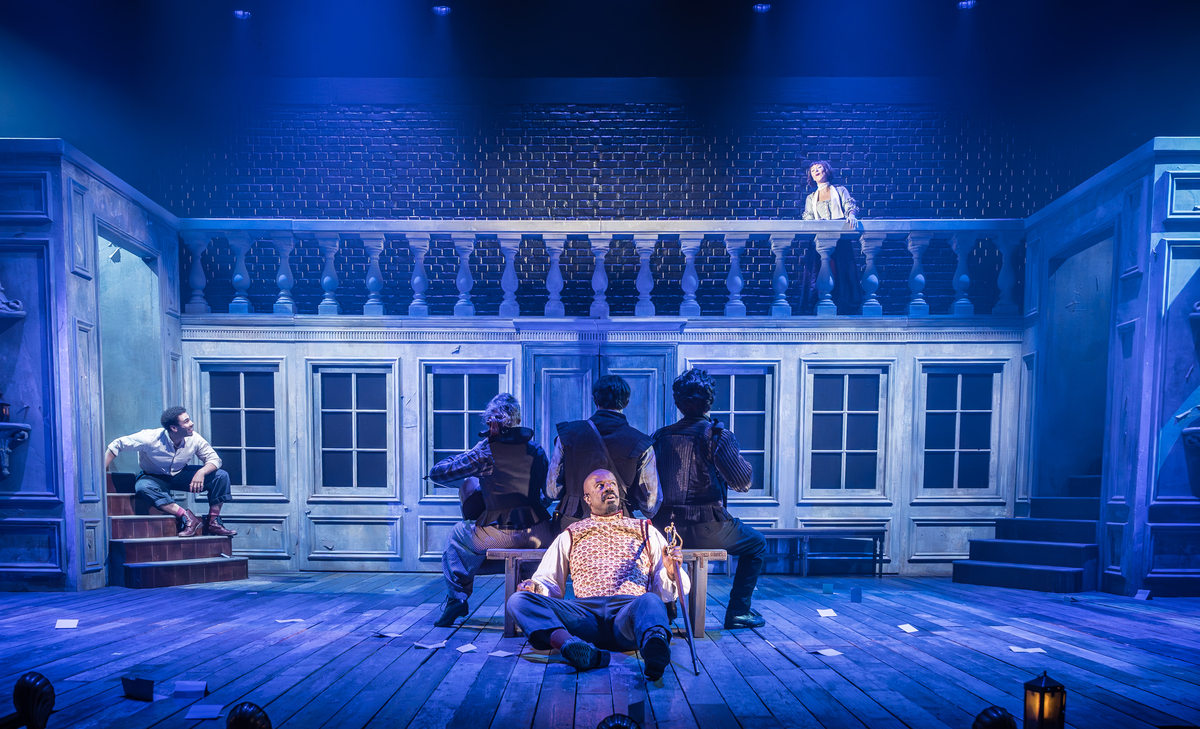 Adrian Lester, Susannah Fielding, and Levi Brown in Cyrano de Bergerac. Photo provided by production.
Adapted from Edmond Rostand's 1897 play by director Simon Evans and playwright-poet Debris Stevenson, Cyrano de Bergerac is a familiar story even for those who’ve never encountered the source material, with a trope that has played out across romance, comedy, and tragedy. Cyrano is a notorious duelist and poet, undeniably clever with a masterful wit, but deeply insecure about his abnormally large nose. He’s madly in love with his childhood friend, the recently widowed Roxane, but she has her sights set on the handsome but inarticulate Christian de Neuvillette. So Cyrano sets off to help Christian woo Roxane by writing love letters on his behalf.
Adrian Lester is truly brilliant as Cyrano - commanding and charismatic in every scene, delivering his rapid-fire witty zingers and acerbic verbal beatdowns with gleeful confidence. He embodies the character’s pride and bravado, but also allows his deep-seated insecurities to shine through in subtle ways. Susannah Fielding is charming, vibrant, and girlish as Roxane, imbuing her with a spunky agency that she didn’t quite have in the source material. Levi Brown is the weakest link in the trio. He gets a lot of laughs as the empty-headed pretty boy, but doesn’t give him much depth or nuance except in a few scenes.
This is also perhaps due to the fact that the plot is a little shaky, dragging on with overly long conversation scenes in places and rushing quickly over key events in others. It means we have little time to get invested in the bizarre love triangle and the unique, confused dynamic between the three characters, and less space to unpack their complicated feelings about each other before we get to the dramatic conclusion.
The first act of the play leans heavily into comedy, starting with a madcap chase sequence through the theatre as characters search for Cyrano, who’s poised to make his dramatic entrance. The second act is more serious, focusing heavily on the Thirty Years War, with Cyrano and Christian at the front lines. It’s a deliberate pivot, but means the story often feels a bit tonally dissonant, shifting awkwardly between serious and satirical.
But one can’t fault the script, where Stevenson’s talents as a poet truly shine through. The dialogue is lush and poetic, packed with wit and emotional depth. The storytelling is embedded with symbolic imagery, such as the spectre of a little boy who haunts the periphery of the stage, and a tree that blooms from the centre, shedding its leaves during the heartbreaking final scene.
The adaptation also introduces a sense of complexity to the characters and story. It critically examines the ‘Cyrano trope’, highlighting the flaws and moral conundrum in seducing someone using somebody else’s words - what we today would probably call catfishing - and the limitations of language in capturing the nuances of love. Cyrano is driven by self-loathing rather than altruism, and Roxane is rightfully angry at him for denying her the chance to choose who to love, while she herself is clearly more in love with the idea of love than the thing itself, demanding pretty verse instead of honesty. In this way, Christian also feels like a victim of the ruse, denied agency in his own romance when all he wants is simplicity and straightforwardness. There’s no clear victor among the trio, and no hero or villain, which makes them feel fascinatingly complicated and authentic. The iconic scene where Christian woos Roxane on the balcony while Cyrano mouths his lines to him from out of sight is played for laughs, full of slapstick comedy, but also feels tragic through this lens. It's during moments like these that the play perfectly strikes the balance of tragicomical.
In this respect, the production almost feels modern in its tone and themes, which might have felt anachronistic with Grace Smart’s 17th century set with its ornate costumes and the musketeer-style sword-play, but works effectively here and lends the adaptation a degree of psychological depth to balance out the entertaining action and comedy.
The production also carries a wonderful sense of self-aware theatricality, opening with a play-within-a-play in a Parisian theatre, where actors dash through the real-life audience, and characters and musicians appear in the boxes, blurring the lines between the imaginary theatre and the real one. A delightful touch is the troupe of musicians whom Cyrano won in a bet and who follow him around, even into war, providing both comical and dramatic musical cues at appropriate times.
Cyrano de Bergerac is, like its hero, not without its flaws, frustrating in places, both funny and tear-jerking, with a tendency to be excessively verbose, but undeniably charming throughout.
Latest News

 Review: ILFORD BOY at Donmar Warehouse
23 October 2026 at 12:59
Review: ILFORD BOY at Donmar Warehouse
23 October 2026 at 12:59
 Review: DERREN BROWN: ONLY HUMAN at Apollo Theatre
22 October 2026 at 23:00
Review: DERREN BROWN: ONLY HUMAN at Apollo Theatre
22 October 2026 at 23:00
 Secret Cinema announces initial casting for DISNEY'S PIRATES OF THE CARIBBEAN: THE IMMERSIVE ADVENTURE
22 October 2026 at 14:48
Secret Cinema announces initial casting for DISNEY'S PIRATES OF THE CARIBBEAN: THE IMMERSIVE ADVENTURE
22 October 2026 at 14:48
 THE MOUSETRAP celebrates 75th anniversary with new cast, director, and redesign
22 October 2026 at 14:24
THE MOUSETRAP celebrates 75th anniversary with new cast, director, and redesign
22 October 2026 at 14:24