
Review: DARK OF THE MOON at Charing Cross Theatre
Advertised as ‘a new musical’, Dark of the Moon is very much an old story - adapted from a play written in 1939 by Howard Richardson and William Bernley, which itself was based on the centuries-old ballad of Barbara Allen. With a book by Jonathan Prince, the musical, now playing at Charing Cross Theatre, still feels like an old, familiar story, with many recognisable tropes, but a unique musical and aesthetic flair makes it refreshing and engaging despite some inevitable cliched storytelling beats.
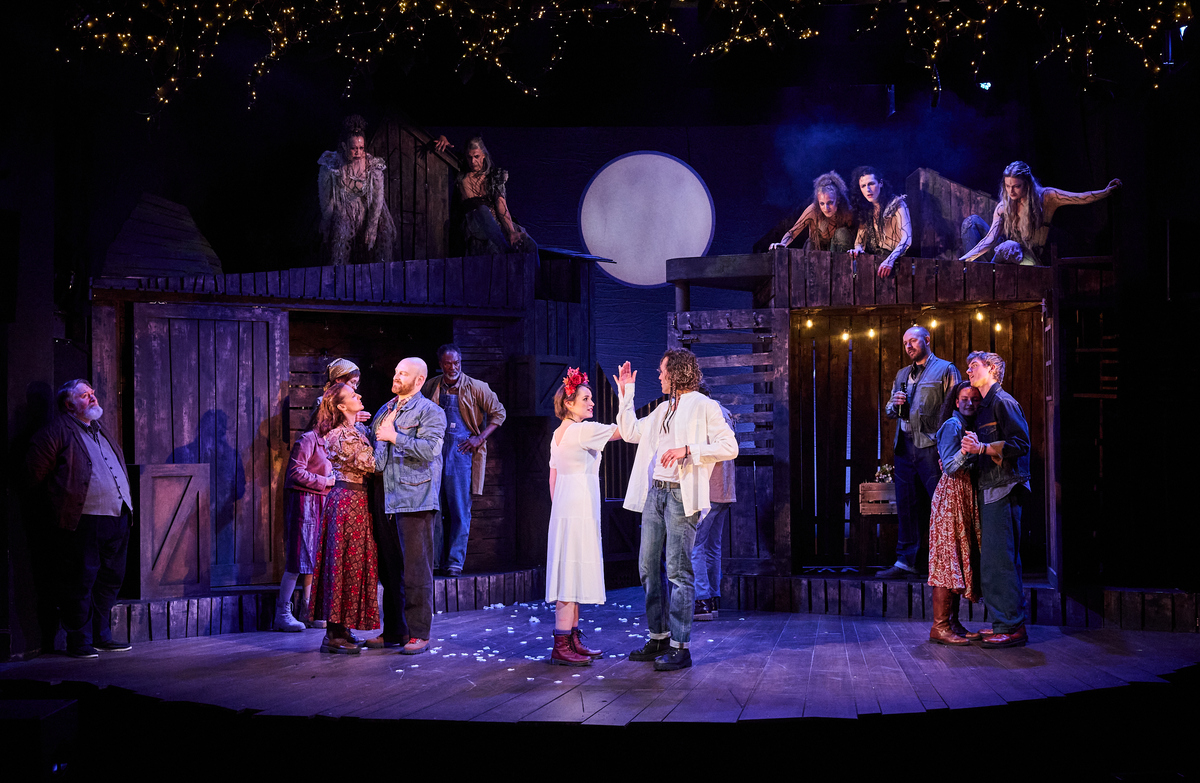 The cast of Dark of the Moon. Photo by Tom Bowles.
In the shadow of the Smoky Mountains, Buck Creek is an ordinary town, its people oblivious to the witches that creep down from the mountains to walk unseen among them. Barbara Allen, a young girl who’s never fit in, falls in love with John, a witch boy who dreams of being human. John strikes a deal with the leader of his coven which allows him to become mortal and be with Barbara Allen, provided the two remain faithful to each other for a year. But love might not be enough to protect them from the witches’ meddling and the townsfolk’s prejudices.
The story of Dark of the Moon itself is a little cliche: star-crossed lovers, a misfit girl, an immortal who longs to be mortal, a prejudiced small town driven into a frenzied mob - all tropes we’ve seen occur in everything from fairy tales and myths to modern romantasy fiction and paranormal teen dramas. But despite that, the musical manages to feel charming rather than trite.
A lot of this comes down to director Georgie Rankcom’s creative choices. Music is used as a device to show the disparity between the world of humans and the world of witches, with bluegrass/country tunes associated with the human characters while the witches’ musical numbers are heavy rock anthems. The tone is immediately set during the opening, when the quaint, rustic ‘Ordinary Life’, performed by the townsfolk going about their day, is interrupted by the arrival of the witches, bursting into a belting performance of ‘Under Our Spell’. It’s delightfully jarring, and utterly effective in preparing us for the dichotomy of musical styles that characterise the score.
The songs themselves are occasionally kitschy (with lyrics like “life’s a bitch, glad I’m a witch”), but overall catchy, entertaining, and memorable. The witches’ musical numbers are especially fun, with high-energy choreography and gleefully irreverent lyrics. From the title song ‘Dark of the Moon’, where Conjur Woman makes her deal with John, to ‘Certified Badass’, where John reminisces about his glory days as an immortal - they feel like equal parts rock concert and witchy ritual.
The witches themselves are the highlight of the show. Covered in tattoos and dressed in mesh bodysuits and tattered rags that give them an otherworldly air that sets them apart from the humans in their folksy outfits, they move and dance with a sort of animalistic prowl. The real scene-stealers are Al Knott, Appolilly Szarc and Jordan Broatch as Raven, Arwen, and Devin, the trio of cackling, jeering witches who pop up to sneer at the banalities of human life and try to seduce John back into the hedonistic lifestyle of the coven. Josie Benson is also formidable as the coven leader Conjur Woman, with a powerhouse of a voice and a terrifyingly commanding presence.
In contrast, the human characters feel more like archetypes - the kindly preacher, the judgmental midwife, the jealous town boy who pursues Barbara Allen - but a talented cast makes them feel endearing and authentic. The same goes for the two leads, whose characterisation feels a bit flat, and who fall in love more quickly than feels believable. But Lauren Jones brings a raw vulnerability to the sassy, willful Barbara Allen, with a phenomenal voice that turns her solo numbers like ‘Wildflower’ and ‘Unthinkable’ into real tearjerkers. Glenn Adamson channels Bat Out of Hell’s Strat with his throaty, electric rock performances, while bringing a puppyish earnestness to John as he struggles to adapt to being human.
Libby Todd’s set design is largely minimalist, with two wooden structures that double as dwellings and a general store, creating the suggestion of a sprawling town beyond them. We never see the witches’ home; instead they crawl around the rooftops, encroaching into the human world. They move unseen through the oblivious townsfolk, speaking without being heard, giving the sense of two polarised worlds coming into conflict, but also creating moments when we see how alike the two sides are in their prejudices. Jonathan Chan’s lighting design is particularly effective, illuminating the backdrop of the mountains and a full moon, which changes colour to reflect the mood of different scenes. It creates an ethereal, mystical, and deeply haunting setting that gives the musical its unique and alluring aesthetic.
Cliched and often predictable though it may be, there’s a deep poignancy in the musical’s underlying message: “Being human is heartbreak,” as Conjur Man warns John, setting up the driving question of the story, which interrogates what it means to be human, and whether love is worth all the pain and grief that comes with it. It gives Dark of the Moon a strong emotional core, which, along with its memorable aesthetics and musical style, means it leaves a powerful impression.
Latest News
 Review: DOG MOM at Southwark Playhouse Borough
17 October 2026 at 00:35
Review: DOG MOM at Southwark Playhouse Borough
17 October 2026 at 00:35
 THE GUILTY to transfer to West End in 2027
16 October 2026 at 15:55
THE GUILTY to transfer to West End in 2027
16 October 2026 at 15:55

 Review: CADEL: LUNGS ON LEGS at Riverside Studios
16 October 2026 at 13:04
Review: CADEL: LUNGS ON LEGS at Riverside Studios
16 October 2026 at 13:04
 David Tennant to star in revival of THE ENTERTAINER
16 October 2026 at 12:26
David Tennant to star in revival of THE ENTERTAINER
16 October 2026 at 12:26