
Review: AN IDEAL HUSBAND at the Lyric Hammersmith Theatre

Oscar Wilde’s An Ideal Husband is currently running at the Lyric Hammersmith Theatre, adapted by the Lyric’s Associate Director Nicholai La Barrie. Despite being arguably one of Wilde’s most ingenious plays, it remains surprisingly one of the lesser staged of his works.
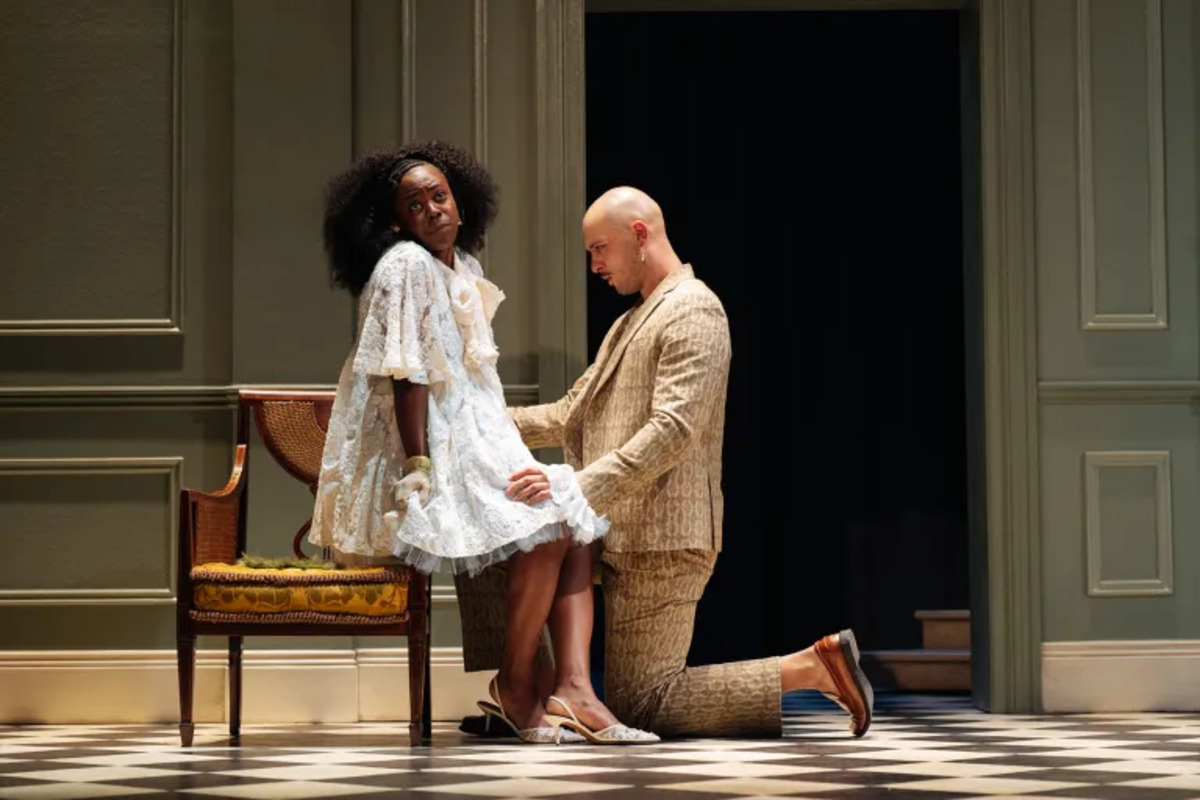 Tiwa Lade and Jamel Westman in An Ideal Husband. Photo by Helen Murray.
The plot follows Sir Robert Chiltern, a successful Member of Parliament and government minister whose comfortable life is threatened by the arrival of Mrs Cheveley, a woman who knows his darkest secret and uses it to blackmail him. The core themes of political scandal, regret and corruption, are typical of Wilde, as are explorations of gender norms, morality and sexual misconduct. Broadly, these anxieties reflect the insecurities of late Victorian society, where industrialisation and globalisation brought an influx of outside ideas and influences, causing old social structures to rapidly erode. What is striking, however, is how enduring these themes remain. Modern cancel culture, anti-immigration rhetoric, as well as shifting gender dynamics following movements such as MeToo and the rise of the ‘manosphere’, all echo the same societal tensions Wilde interrogated over a century ago. Few writers so succinctly capture this feeling that at the heart of society there is a constant tug-of-war between progress and conservatism, which makes the opportunity to watch an adaptation of his work on stage so alluring.
La Barrie’s adaptation does well to capture the shock and provocation one expects from Wilde and it is a thrill to see Wilde’s famously lyrical dialogue come to life here, as his characters lie, manipulate and challenge one another to extremes. La Barrie’s most effective slant on Wilde’s play, however, comes through the integration of Caribbean social politics, with a cast wholly of Caribbean and African heritage. In some respects, Caribbean culture remains deeply religious and socially conservative in ways comparable to late Victorian society, particularly regarding gender roles and homosexuality. This adaptation cleverly reframes Wilde’s critique through a contemporary cultural lens, drawing on this Caribbean perspective that is too rarely explored in theatre.
The show feels entirely in keeping with Wilde’s own instinct to challenge repressive social rhetoric and expose the hypocrisies underpinning supposedly respectable society. It also follows other recent Wilde adaptations that have explored parallels between supposedly regressive aspects of Caribbean culture and late Victorian social values, most notably The Importance of Being Earnest at the National Theatre, which cast Sharon D Clarke as a Caribbean Lady Bracknell, a reinterpretation almost better than the original.
This cast is exceptional at capturing the liveliness, wit and chaos that define An Ideal Husband. Jamael Westman particularly shines as Lord Goring, abundantly evoking Wilde’s razor-sharp wit and understated wisdom. His performance is suave, charismatic and quietly profound and an absolute joy to watch.
Other highlights include Emmanuel Akwafo as Mason/Phipps, whose comic timing and expressive reactions provide some of the production’s funniest moments. Likewise, Jeff Alexander delivers an entirely recognisable Caribbean elder as Lord Caversham. His portrayal perfectly embodies old fashioned Caribbean attitudes and generational conservatism, particularly in scenes where he berates Lord Goring for idleness and dismisses women as naturally lacking common sense. Here, he is almost a living symbol of the outdated social structures Wilde sought to undermine. Tiwa Lade is also excellent as Mabel Chiltern, bringing warmth, charisma and charm to the role. Her chemistry with Lord Goring is consistently believable and often laugh-out-loud funny, making their dynamic one of the best parts of the play.
Wilde was unusual for his time in writing female characters with genuine complexity and emotional range; however, this production sadly underuses Lady Chiltern and Mrs Cheveley (played by Tamara Lawrance and Aurora Perrineau respectively). Both actresses are undoubtedly talented, but their performances occasionally feel too emotionally restrained. Moments that should carry greater emotional weight, such as Lady Chiltern discovering her husband’s corruption or Mrs Cheveley losing control before using her quick tact and manipulative skills to regain it, never fully land with the intensity they require. Since these two women drive much of emotional weight of the plot, their presence needed to feel stronger and more enlivened.
This production does well to heighten Wilde’s humour and social commentary through movement, visual cues and physicality. Between scenes, upbeat contemporary music accompanies stylised posing and dancing, whilst body language is used deliberately to communicate power dynamics and character relationships. The costumes are particularly effective: contemporary fashion infused with Caribbean and African influences feels every bit as extravagant and theatrical as the elaborate Victorian clothing Wilde himself would have known. Likewise, the sleek Country-House set design and vibrant lighting, including occasional strobe effects, contribute to the heightened sense of spectacle and flamboyance that characterises this fictional world.
The production also includes subtle cultural references that enrich the adaptation, such as the brilliant Tabasco-in-the-handbag scene. However, there are moments where the production risks prioritising style over substance when it could do with being a little, dare I say, messier? Indeed, whilst visually bold, it occasionally hesitates to fully interrogate the deeper sexual and gender politics embedded within Wilde’s writing. Judging from this production’s marketing, I expected a more radical exploration of gender performance and sexuality. Yet I found that beside the script there seemed to be little additional risk taken in this regard. Certain opportunities, like the implications surrounding the ‘love letter’ from Lady Chiltern to Lord Goring, could have pushed further. At times, the adaptation feels strangely cautious about engaging too deeply with bolder themes like sexuality, which is unfortunate given that Wilde’s work fundamentally thrives on challenging social and sexual boundaries.
Nevertheless, the themes of reputation, honour and family become even more potent when filtered through Caribbean social expectations. Similarly, Lord Chiltern’s predicament strongly echoes contemporary cancel culture, as the threat of public exposure jeopardises both his career and family life. One particularly effective scene occurs after Lady Chiltern discovers the truth about her husband, only for him to manipulate the situation into seeming partially her fault, we are introduced to an almost modern sense of gaslighting that works remarkably well within Wilde’s framework, proving once again how well suited Wilde’s plays are for re-interrogation.
Ultimately, this is a stylish, energetic and highly entertaining adaptation of Wilde’s work. Nicholai La Barrie succeeds brilliantly in re-contextualising the play through a Caribbean cultural lens, bringing a new angle to Wilde’s wit and theatrical extravagance that I’m sure Wilde himself would have loved. Yet although the production embraces visual boldness, it stops just short of fully committing to the provocative radicalism that makes Wilde such an enduring and dangerous playwright.
Latest News

 Interview with THE HUNGER GAMES: ON STAGE's Aiya Agustin
13 October 2026 at 14:43
Interview with THE HUNGER GAMES: ON STAGE's Aiya Agustin
13 October 2026 at 14:43
 Production photos released for THE CHERRY ORCHARD
13 October 2026 at 14:35
Production photos released for THE CHERRY ORCHARD
13 October 2026 at 14:35
 NANNY MCPHEE musical confirms dates and venues
12 October 2026 at 14:50
NANNY MCPHEE musical confirms dates and venues
12 October 2026 at 14:50
 Sacha Baron Cohen to star in Quentin Tarantino's THE POPINJAY CAVALIER
12 October 2026 at 12:30
Sacha Baron Cohen to star in Quentin Tarantino's THE POPINJAY CAVALIER
12 October 2026 at 12:30