
Review: DEAR LIAR at Jermyn Street

This is not a love story. George Bernard Shaw and Beatrice Stella Tanner spend most of DEAR LIAR married to people other than each other, and there’s no steamy romantic affair between them.
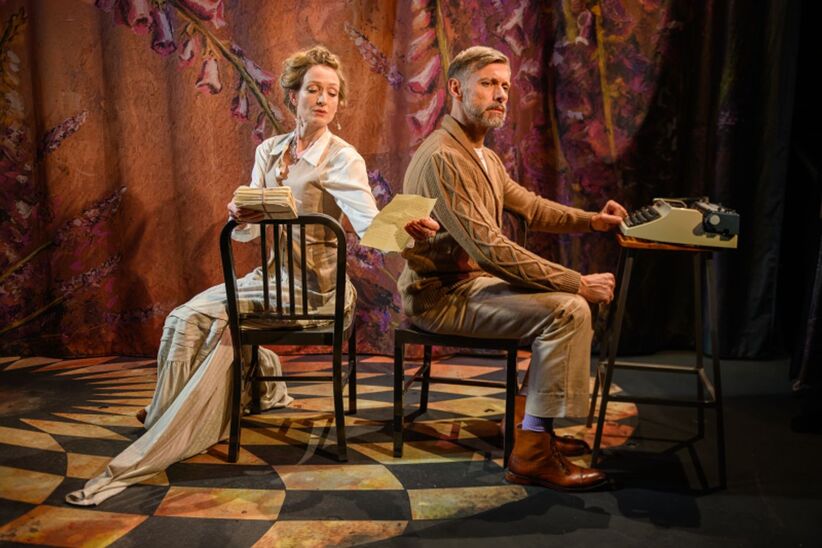 Rachel Pickup and Alan Turkington in Dear Liar. Photo by David Monteith-Hodge
Shaw may be the better-known figure, but as a character, he’s a rather one-note crotchety genius, whose anger at not finding a famous enough actor to play Higgins in Pygmalion registers at about the same level as his anger about the deaths of soldiers in the First World War. Alan Turkington puts in a slick, convincing performance as the irritated visionary. As Stella, Rachel Pickup is magnetic, her beautiful voice making Stella’s star quality believable. She also has the more interesting story. While Shaw grouches about work and the world, Stella suffers a serious injury, stars as Eliza Doolittle at the age of 49, experiences professional ups and downs in both Europe and the USA, loses both her first husband and her son to war, and has an uneven second marriage. Pickup’s warmly grand performance of a woman experiencing this eventful life means that Stella is the more intriguing character.
Tom Paris’ minimalist set is dynamic enough to be visually engaging, but restrained enough to ensure that the focus is on the actors and their words. However, despite these being the words of a celebrated actress and Nobel Prize-winning playwright, it’s in the words where DEAR LIAR is at its weakest. Kilty devised DEAR LIAR in the 1950s, after Shaw and Stella’s correspondence was published once they had both died. It is sometimes difficult to make two actors’ spoken back-and-forth convincing given that their words were initially written down and responded to days or weeks later. There is plenty of witty repartee, but it doesn’t always work out of the context of its original letter. The pacing of Kilty’s play could also be improved, as much of DEAR LIAR’s first act focuses on the writing and rehearsal of Shaw’s Pygmalion in the early 1910s, leaving the second act to zip through the subsequent 26 years of correspondence until Stella’s death in 1940. I couldn’t help but consider that DEAR LIAR seemed a dated way of writing an epistolary play, and that a 21st-century of the adaptation of the source material would put a more inventive and dynamic spin on Shaw and Stella’s correspondence.
It’s a refreshing relief that director Stella Powell-Jones doesn’t attempt to crowbar any excess melodrama into Dear Liar. Shaw and Stella’s connection is complex, based as much on business as it is on emotional attachment. While the relationship borders on romantic at times, it’s never suggested that Dear Liar’s protagonists could, or could even want to, run off into the sunset together.
As a script, DEAR LIAR doesn’t do justice to its central characters, but the Jermyn Street Theatre’s strong production enhances Kilty’s play through strong performances and smart directing choices.
Latest News

 Production photos released for world premiere of AFFLUENZA
2 October 2026 at 14:53
Production photos released for world premiere of AFFLUENZA
2 October 2026 at 14:53
 Charlie Cox to star in world premiere of THE KING'S RANSOM
2 October 2026 at 14:02
Charlie Cox to star in world premiere of THE KING'S RANSOM
2 October 2026 at 14:02

 Review: BULL at Park Theatre
1 October 2026 at 23:51
Review: BULL at Park Theatre
1 October 2026 at 23:51
 New musical LITTLE DANCER to have West End premiere in 2027
1 October 2026 at 16:38
New musical LITTLE DANCER to have West End premiere in 2027
1 October 2026 at 16:38