
First Look: A MIRRORED MONET at the Charing Cross Theatre
There’s a certain charm in seeing historical figures come to life onstage, reshaped as characters in a story that we can relate to and empathise with. Carmel Owen’s A Mirrored Monet, inspired by the artist and his peers’ letters and diaries, is rich with historical detail, but also manages to humanise and demystify Monet through its storytelling, so that we find ourselves simultaneously immersed in the art world of Belle Epoque Paris as well as in the deeply complicated psyche of Monet himself.
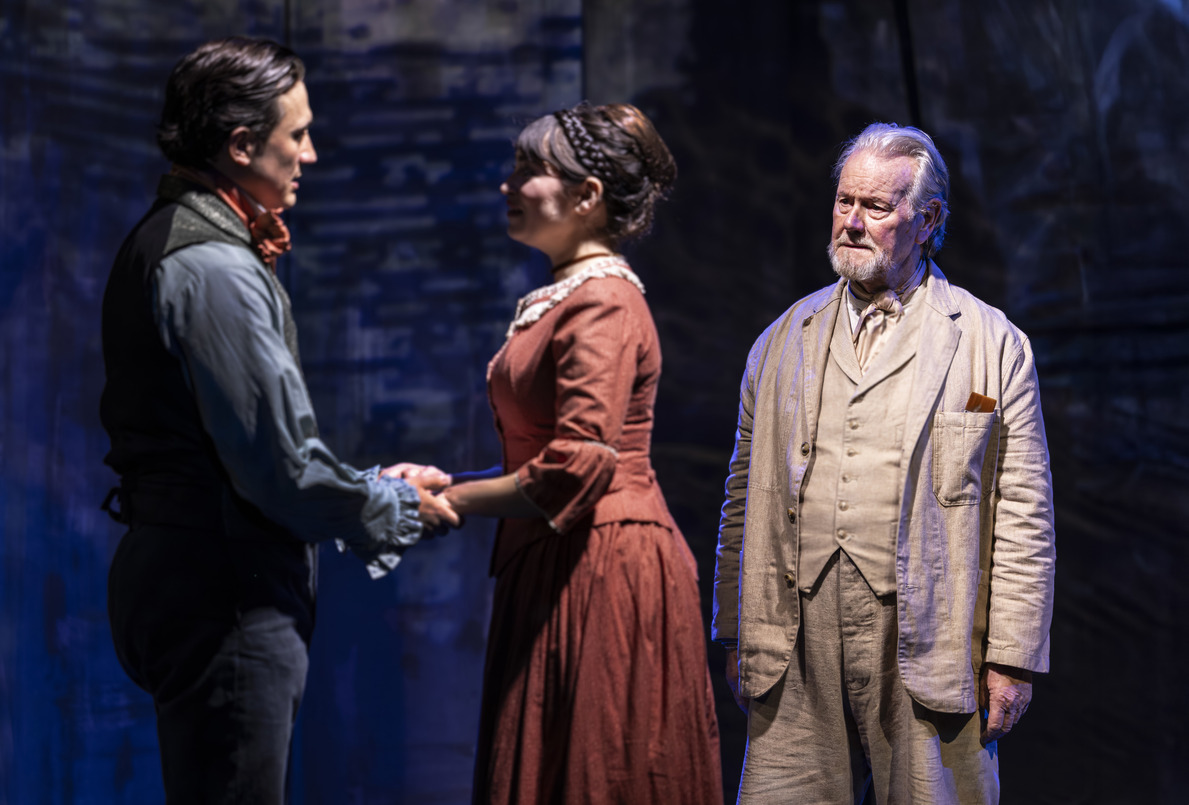 Dean John-Wilson, Brooke Bazarian, and Jeff Shankley in A MIRRORED MONET. Photo by Pamela Raith.
The musical, directed by Christian Durham, opens in 1916, where a cantankerous, elderly Claude Monet (played by Jeff Shankley) is wrestling with both his failing eyesight and a creative block as he attempts to complete the painting that will become his magnum opus: 'The Water Lillies'. He finds himself reminiscing about his youth as a struggling artist in Paris, and the musical jumps back in time to follow a younger Monet (played by Dean John-Wilson), trying to make his name alongside his friends Renoir (Sam Peggs) and Bazille (Ritesh Manugula) under the tutelage of their mentor Manet (Aaron Price-Lewis), while falling in love with model Camille Doncieux (Brooke Bazarian), who would become his muse and wife.
The concept of a character observing and reliving their past isn’t a new one in theatre - MJ the Musical follows a similar plot with an older Michael Jackson looking back on his younger self. But it makes for a fascinating storyline, as we see the disconnect unfold between the past and present Monets. The younger Monet is idealistic and consumed by his craft; the older Monet is embittered and cynical, resentful of his younger self for prioritising his work over his family, which he sees now was his true masterpiece.
There’s something deeply tragic in witnessing his anguished reactions to the events of his history, helpless to change any of it. Shankley captures the elder Monet’s inner turmoil with both gravitas and emotional depth that never gives over to melodrama. In contrast, John-Wilson’s younger Monet feels a little more one-note, sometimes over-the-top in his deliveries, but the two actors play off each other in a way that makes it easy to see them as one person at different points in his life.
The most thrilling aspect for me, and anyone interested in art history, was seeing the birth of the Impressionist movement play out, and the resistance its abstract approach received from the stodgy traditionalists of the Beaux-Arts Salon, who are determined to uphold the 'golden age' of French art, with its more realistic style. It certainly got a few ironic chuckles out of the audience to hear the Marquis (Steven Serlin) and the critic Leroy (John Addison) scoff at the idea that Monet or Renoir’s paintings would ever hang in the Louvre.
The dynamic between the young Impressionists, still on the cusp of greatness, is also charming and entertaining to behold. Whether they’re complaining about being broke because they can’t sell their paintings, flirting with models, or debating their artistic techniques and teasing Monet for his habit of painting en plein air (outdoors), it all feels delightfully relatable - especially to any young person trying to break into the creative industry. Peggs steals most of the scenes he’s in, as the charming, flirtatious Renoir, always quick with a rapid-fire quip.
In contrast, the romance between Monet and Camille, which takes centre stage, feels less compelling. In many ways it’s slightly cliche - the genius who neglects his wife in favour of his craft is a familiar story in history as well as fiction. But it’s obvious that one of the musical’s aims is to give Camille her moment in the spotlight after being overlooked and forgotten by history - much in the same way Hamilton does for Eliza Hamilton. So one can forgive the inclusion of a slightly overdone, if still extremely poignant and moving, love story.
However, the musical’s biggest weakness, unfortunately, is its soundtrack. Many of the songs are unmemorable at best and trite at worst, rarely doing justice to the emotional depth and complexity of the stories being told and never really propelling the narrative forward. Bazarian’s stunningly powerful vocals are a saving grace, making her numbers resonate despite some so-so lyrical choices, with special mention going to ‘There Are No Stars’, where Camille wanders the streets of Paris in despair. I also had a soft spot for ‘In the Light’, performed by John-Wilson as Monet describes his artistic technique and his way of seeing the world. But overall, I wondered if the show really needed to be a musical, and whether it would have worked better as a play.
Under Libby Todd’s design, the backdrop is made up of blank canvases, onto which scenes of Paris, London, or Giverny, as well as replicas of paintings, are projected. The effect is certainly immersive, visually dazzling to experience, and often thrilling when you recognise iconic pieces of art, such as Monet’s 'Impression, Sunrise', which gave the Impressionist movement its name. Occasionally, however, it feels ever-so-slightly gimmicky, as if one has stepped into the Monet: The Immersive Experience exhibition.
But despite its flaws, A Mirrored Monet manages to be deeply moving and emotional as an ode to one of the greatest painters of the 20th century. Its real strength lies in the way it is able to make the characters feel rich and vividly realised, more real than the distant historical figures we know them as, and how well it captures the tragedy of being unable to undo the mistakes of the past. Cliche in places, but overall powerful.
Last Updated on: 13 May, 2026
Latest News
 Review: THE PASS at The Pearly Queen Theatre
18 September 2026 at 23:58
Review: THE PASS at The Pearly Queen Theatre
18 September 2026 at 23:58

 Cast announced for new musical NERO
18 September 2026 at 16:20
Cast announced for new musical NERO
18 September 2026 at 16:20
 Review: MAN TO MAN at Royal Court Theatre
18 September 2026 at 09:16
Review: MAN TO MAN at Royal Court Theatre
18 September 2026 at 09:16
 Megan Hilty and Rachel Tucker to star in concert production of GENTLEMEN PREFER BLONDES
17 September 2026 at 16:46
Megan Hilty and Rachel Tucker to star in concert production of GENTLEMEN PREFER BLONDES
17 September 2026 at 16:46