
Review: A MIRRORED MONET at Charing Cross Theatre

There are many creative talents who have been inspired by other creative talents and have sought to honour the objects of their devotion. Composer, lyricist and book writer Carmel Owen is one such individual. Ms Owen has committed herself to bringing Claude Monet’s life to a musical theatre loving audience, without shying away from the women in his orbit and the substantial contributions they made to his work, life and legacy.
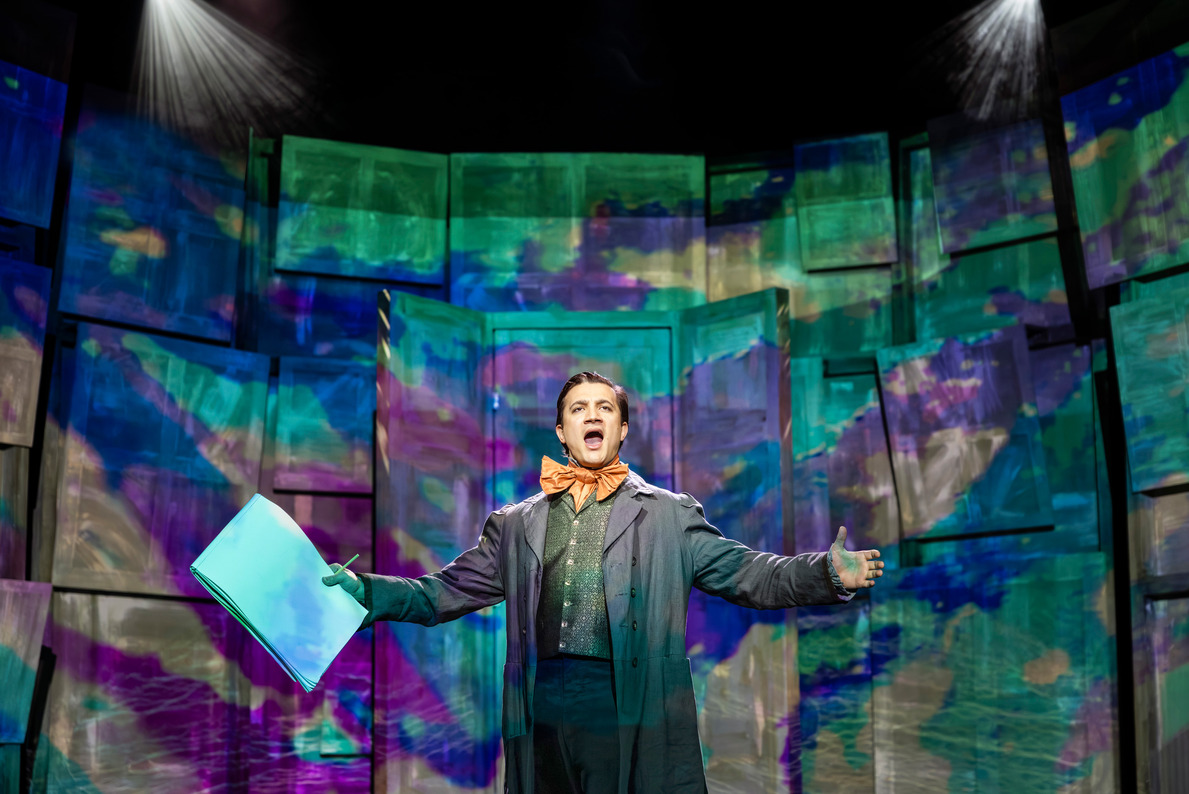 Dean John-Wilson in A MIRRORED MONET. Photo by Pamela Raith.
Having previously joined the creative team one afternoon during the rehearsal period, I was eager to experience the finished production now that it has opened at the Charing Cross Theatre. So I went along to the press night on Tuesday to determine for myself whether the production lived up to expectations and more particularly whether A Mirrored Monet stands on its own as a creative endeavour?
The answer, is very much a mixed canvas. Libby Todd’s set is reminiscent of a cluttered garret adorned with the creative paraphernalia of a struggling artist - whilst centre stage is a screening device which afford moments of cleverly executed lighting changes and projection. It is where we first encounter Monet, the giant of French Impressionism, as his older self (Jeff Shankley). He stands before an unfinished work bemoaning the mental block and failing eyesight which hamper his attempts to complete the giant commission of Water Lillies at his home at Giverny. The bustling young woman who cajoles and berates him, is Blanche (Natalie Day) the daughter from his second marriage, but rather than explore that dynamic further, we are transported to the younger Monet’s (Dean John-Wilson) juvenile interactions with mentor Edouard Manet (Aaron Pryce-Lewis), fellow young artists Renoir (Sam Peggs) and Bazille (Ritesh Manugula) as they attempt new ways to capture models Suzanne (also played by Ms Day) and Camille Doncieux (Brooke Bazarian). Claude and Camille’s burgeoning romantic union soon results in a child, but complications resulting from the birth cause doctors to warn against ever attempting a second pregnancy. Coupled with the strains of poverty resulting from Monet’s disapproving father who withholds financial support, and the gatekeeping of the traditionalists who held sway over the jury at the Paris Salon — Leroy (John Addison) and the Marquis (Steven Serlin) — life proves far from easy and the cracks begin to show.
Directed by Christian Durham with live accompaniment by an 8-piece band under the stewardship of Michael Webborn, the songs come thick and fast but remain ponderous and lack sufficient melodic originality to imbue any tune with that elusive ingredient, memorability. 'Keep Smiling', Blanche’s reflective solo, comes close. Otherwise, the show suffers from a lack of any uplifting or playfully comic numbers which would transport us to the age of living and loving in Bohemian Paris. During the rehearsal period, I asked the composer how she would counter the obvious parallels which some would draw between her focus on Monet and his muse Camille, and that of Georges and Dot (from Sondheim’s Sunday In The Park With George). Her response was that her show was about the man, whereas Sondheim’s was essentially about an artwork. I wondered at the time whether the simplification would prove entirely apposite.
Suffice to say, whilst everyone involved with A Mirrored Monet has committed wholeheartedly to its success, the scenes they are attempting to lift from the book feel rather dry and akin to a well-researched biographical lecture rather than a heartfelt piece of entertainment a la La Boheme. As such, we never truly engage with the characters or feel invested in their outcomes. Perhaps with greater emphasis on Camille and her brief but inspirational life and less on Monet’s retrospective hand-wringing, there would be a stronger show. Certainly I would be inclined to greater sympathy for Camille - Monet’s Muse, than I shall ever feel for an irresponsible and selfish old man who suffers pangs of guilt in his dotage. With a few tweaks and reworking by someone not-so-close to the material, the work has potential, but in its present state it will remain a fusty relic akin to those paintings exhibited at the Salon prior to the 1874 Exposition, which are so derided by the young bucks in this piece. So in conclusion, the piece would benefit greatly from lighter and more romantic brushstrokes and collaboration might hold the key.
A Mirrored Monet continues at Charing Cross Theatre until 9th May and has a running time of up to 2 hrs 30 mins, including an interval.
Last Updated on: 13 May, 2026
Latest News
 Rehearsal photos released for THE CHERRY ORCHARD
23 September 2026 at 17:26
Rehearsal photos released for THE CHERRY ORCHARD
23 September 2026 at 17:26
 Intermission Youth to present Darren Raymond's JULIUS CAESAR REMIXED
23 September 2026 at 12:59
Intermission Youth to present Darren Raymond's JULIUS CAESAR REMIXED
23 September 2026 at 12:59
 DIRTY DANCING will now open at Prince Edward Theatre in early 2027
22 September 2026 at 15:14
DIRTY DANCING will now open at Prince Edward Theatre in early 2027
22 September 2026 at 15:14
 Fringe hit FLY, YOU FOOLS! to have London debut
22 September 2026 at 14:53
Fringe hit FLY, YOU FOOLS! to have London debut
22 September 2026 at 14:53