
Review: AN IDEAL HUSBAND at Lyric Hammersmith

Oscar Wilde's comedy of manners, morals and political chicanery is given a miniature modern tweaking with a largely black cast imbuing Jamaican dialects and sass where previously a droll superiority held sway. Does the fusion work? In places, but not entirely.
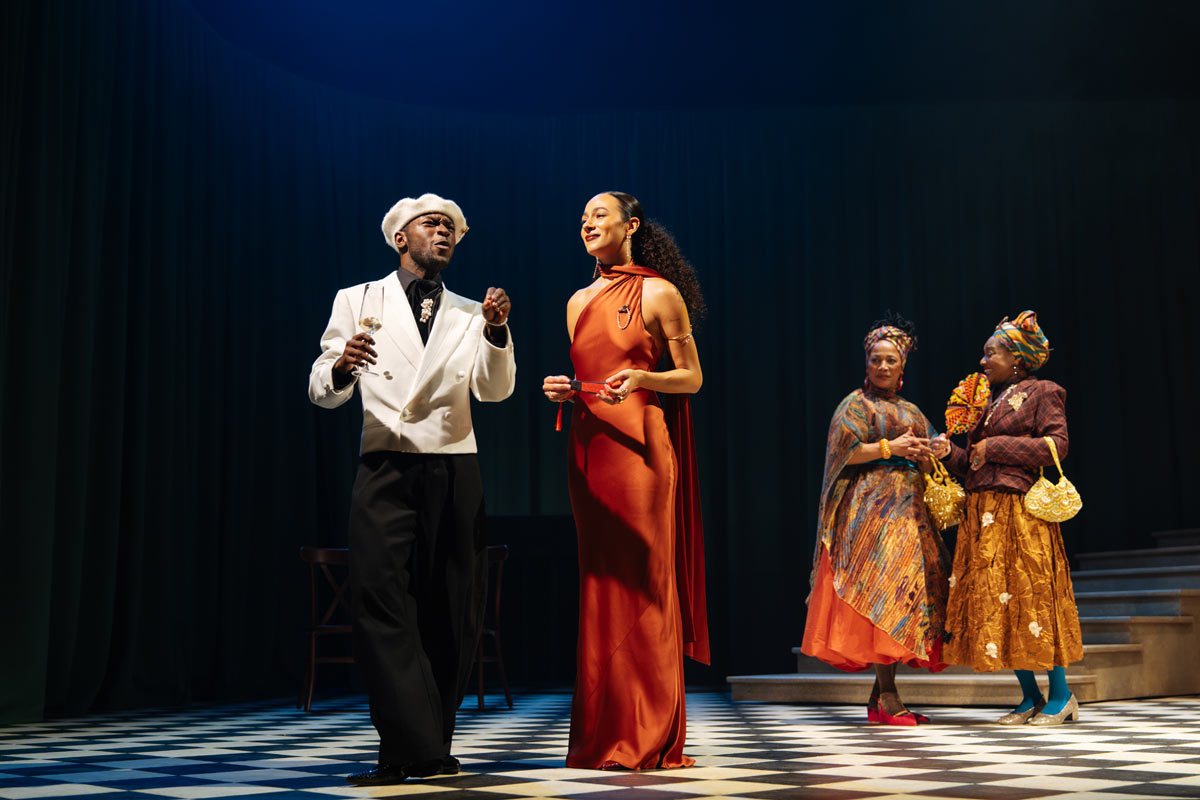 An Ideal Husband - Sule Thelwell, Aurora Perrineau, Nimmy March and Suzette Llewellyn.
My first encounter with AN IDEAL HUSBAND was on Shaftesbury Avenue back in 1992. Peter Hall's altogether traditional production boasted Martin Shaw as Lord Goring and among others, a warmly upstanding Hannah Gordon as Lady Chiltern and Anna Carteret as a coldly malevolent Mrs Cheveley. It was exactly as expected — heavy velvet drapes enveloping the cast and their mellifluous delivery of the rhythms and cadences of Wilde's smart observations and conversational barbs, intoned and timed to perfection. For the current production at the Lyric Hammersmith which is helmed by director Nicholai La Barrie there are nods to the foppish affectation of the period in Rajha Shakiry's beautifully stylish set and costumes, but it is with the text and its delivery, that the production's key shortcomings reveal themselves.
Firstly, whilst the promotional material surrounding the production makes no mention of an adaptation or script changes, in the show's rush to modernise key elements, very definite references have been introduced and it is not always entirely obvious why. Paintings by Basquiat are mentioned more than once (replacing references to Watteau and Van Dyck among others) and the mysterious Baron Arnheim was oddly referred to as Lord Arno but it was unclear whether this was merely a verbal slip (there were many from the actor in question). On the whole the few noticeable updates seemed to jar with the general late-Victorian-meets-modern feel to proceedings and there is clearly a misunderstanding among the creative team of the distinction between Knights and members of the peerage, which is essential in understanding rank which invariably underpins most of Wilde's aristocracy-obsessed work.
Stylistically the acting is varied and in places downright patchy. An austere flamboyance has a definite place in the playwright's drawing room dramas, but when it is deployed purely for the purposes of outlandish scene stealing, it appears amateurish and undisciplined. More than one actor is guilty of allowing themselves to submit to a compunction for overstating their lines, which perhaps the director would have been wise to rein-in during the rehearsal period. In places, it diminishes understanding and in others, renders conversational exchanges clunky, crass and witless, which could hardly have been further from Wilde's intention.
During a lavish party, Mrs Cheveley (Aurora Perrineau) arrives at the London home of Sir Robert and Lady Chiltern (not Lord and Lady Chiltern — rookie error), played by Chiké Okonkwo and Tamara Lawrance. Her professed aim is to expose Sir Robert's unscrupulous early career corruption on which his fortune and reputation were founded. Her price for destroying a letter which incriminates him in the treasonous act, is that he should suppress a negative report about a dubious Argentinian canal project in which she has heavily invested and instead lend the project his support in Parliament. In hiding his youthful misadventure from his wife, he has unwittingly laid the foundations for his undoing. Close friend and confident Lord Goring (Jamael Westman) is consulted and offers to intercede, whereupon various confusions conspire to create a deliciously convoluted outcome.
Westman as Wilde's observer seems particularly determined to use his height and fey charisma to offer a more static and mocking antidote to the overblown characterisations ranged all about him. It helps settle some of the scenes but also adds an element of confusion to the later pursuit and seduction of Mabel in which he attempts to secure the hand of Sir Robert's feisty and coquettish younger sister (Tiwa Lade confidently relishing her every moment on stage).
Ultimately then, a commendable revisionist effort which ultimately falls short due to a lack of understanding of Wilde's pithy time signature, and more particularly, the absolute fundamentals of British snobbery.
Latest News
 Casting announced for the UK premiere of THE PELICOT TRIAL
6 October 2026 at 12:08
Casting announced for the UK premiere of THE PELICOT TRIAL
6 October 2026 at 12:08
 RENT extends booking and releases new production images
6 October 2026 at 11:37
RENT extends booking and releases new production images
6 October 2026 at 11:37
 Glenn Close to play Herod in final week of JESUS CHRIST SUPERSTAR
6 October 2026 at 11:17
Glenn Close to play Herod in final week of JESUS CHRIST SUPERSTAR
6 October 2026 at 11:17
 Review: TOY SOLDIER at Union Theatre
6 October 2026 at 09:07
Review: TOY SOLDIER at Union Theatre
6 October 2026 at 09:07