
Review: CHOIR BOY at Stratford East
Academy Award-winning writer Tarell Alvin McCraney, of Moonlight fame, brings his signature style of imbuing empathy and power into storytelling with a tender, funny, and emotional coming-of-age story directed by Nancy Medina at Stratford East.
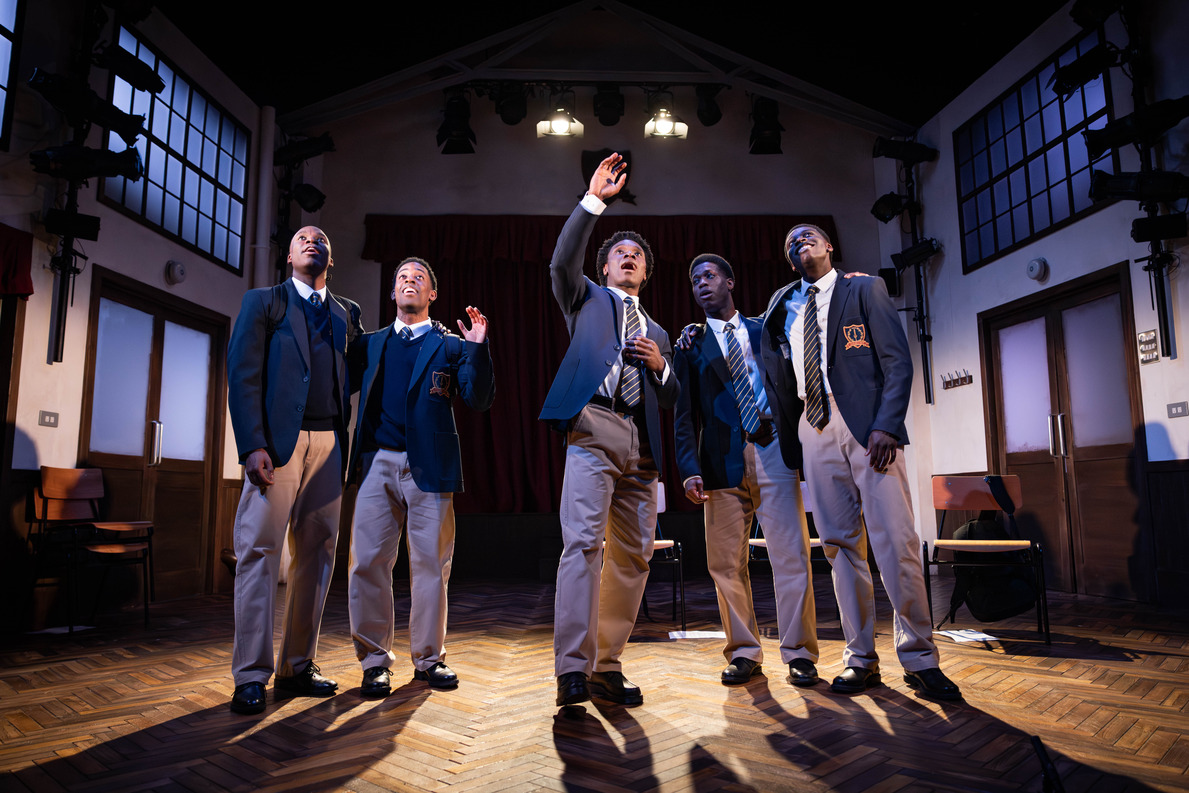 Rabi Kondé, Khalid Daley, Michael Ahomka-Lindsay, Freddie MacBruce and Terique Jarrett in CHOIR BOY. Photo by Mark Senior.
Choir Boy takes place at the prestigious Charles R. Drew Prep School for Boys, ruled by the stern but just Headmaster Marrow (Daon Broni), who has high standards for his students. Pharus (Terique Jarrett) is a confident and gifted scholarship student, driven by his passion for choir and determined to perform at the school’s graduation. But homophobic heckling from another student during a performance reminds him of how much his sexuality makes him an outsider. In their final year at Charles R. Drew Prep, Pharus and the four other boys of the school choir navigate spirituality, sexuality, race, and brotherhood in their journey to becoming men.
A truly talented cast takes the play from something charming and relatable to something truly powerful that had the audience gasping and groaning during key emotional moments, utterly invested in the emotional journeys of these characters. Jarrett is the true breakout star of the performance - he injects the confident, witty Pharus with a sense of cheeky charisma and vulnerability as he walks the line between concealing his queerness and staying true to his authentic, often flamboyant self. The other four boys are equally endearing and engaging: from Bobby (Rabi Konde), whose aggression towards Pharus masks his grief about his mother’s death, to David (Michael Ahomka-Lindsay), whose sudden turn towards religious devotion is at odds with his own identity, to the adorably scatterbrained but earnest Junior (Khalid Daley). Freddie Macbruce is especially endearing as Pharus’s roommate AJ, who is fiercely protective of him and jokingly reciprocates his flirting without an ounce of insecurity about his own straightness.
The cast has incredible chemistry and rapport with each other, which translates into both powerful emotional moments as well as impeccable comedic timing. Pharus’s back-and-forth with the stuffy Headmaster Morrow is particularly entertaining, as is the banter between the five boys, which jumps between boyish colloquialism and the effortless lyricism of McCraney’s writing.
Music plays a significant role in the performance and within the story itself, becoming a way for these young men to express themselves in a society where boys are meant to keep their emotions under wraps. Acapella versions of gospel hymns and spirituals are threaded throughout the play, under Femi Temowo’s musical direction, becoming an integral part of the storytelling. In some places it’s deeply poignant, such as when the boys sing ‘Motherless Child’ in the showers to comfort the grieving Bobby. In other, tenser moments, it becomes a bit jarring and even cheesy, but the cast’s powerful vocals mean every musical interlude is enjoyable and deeply moving.
In contrast, Martin Turner feels a little out of place as Mr Pendleton, the eccentric new teacher who brings to mind Mr Keating in Dead Poets Society, overly earnest and often pushing boundaries in his attempts to open the boys’ minds. A debate sequence during one of his classes goes on ever so slightly too long, enough to disrupt the flow of the narrative, but lends itself to a fascinating discussion on the history of spirituals and the different ways Black Americans engage with their ancestors through the history of enslavement, with Bobby and Pharus butting heads over the authenticity of the legacy of spirituals.
In other places, McCraney is more effectively subtle as he interrogates the way the boys grapple with their identities as Black and queer within the rigid and markedly Christian confines of the school, whose crest of arms looms ominously over the otherwise simple backdrop of Max Johns’ set design. Particularly poignant and powerful are the soft, intimate scenes taking place in Pharus and AJ’s dorm room, where they joke around but also lay bare their innate vulnerabilities and insecurities. Pharus shares a painful story about the first time his queerness made him feel like an outsider among the ultra-masculine men in a barbershop, and AJ responds by offering to cut his hair.
It’s small, quiet moments like these where the play really shines, where the raw emotion of McCraney's storytelling shines a light on the complex nuances of the struggles these characters face in their journey towards adulthood. Bold, funny, and eccentric in places, Choir Boy is at its best in those moments of simple but poignant reflection.
Latest News
 Production photos released for world premiere of AFFLUENZA
2 October 2026 at 14:53
Production photos released for world premiere of AFFLUENZA
2 October 2026 at 14:53
 Charlie Cox to star in world premiere of THE KING'S RANSOM
2 October 2026 at 14:02
Charlie Cox to star in world premiere of THE KING'S RANSOM
2 October 2026 at 14:02
 Review: BULL at Park Theatre
1 October 2026 at 23:51
Review: BULL at Park Theatre
1 October 2026 at 23:51
 New musical LITTLE DANCER to have West End premiere in 2027
1 October 2026 at 16:38
New musical LITTLE DANCER to have West End premiere in 2027
1 October 2026 at 16:38