
Barbican Theatre
Silk Street, London, EC2Y 8DS
Barbican Theatre Tickets
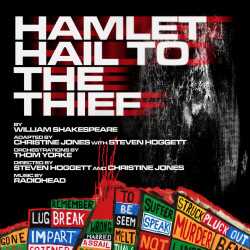
Hamlet Hail to the Thief
Barbican Theatre
Created by Radiohead frontman Thom Yorke, Hamlet Hail to the Thief is a dynamic new version of Hamlet where Shakespeare's words are illuminated by Radiohead's music. Experience Shakespeare's greatest tragedy retold through Radiohead's celebrated album Hail to the Thief, in a unique theatrical experience performed live by a cast of musicians and actors, which combines theatre, music and movement.
- Opens: Saturday, 31 October 2026
Booking until: Saturday, 23 January 2027
- Playing at: Barbican Theatre
- Booking until: Saturday, 23 January 2027
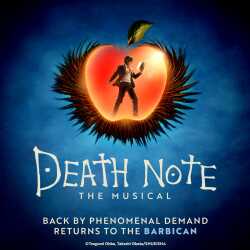
Death Note The Musical
Barbican Theatre
4.9 21 reviews 4.9 21 reviews Tickets from £25.00- Booking until: Saturday, 15 May 2027
- Running time: 2hr 30min. Incl. 1 interval.
- Playing at: Barbican Theatre
- Booking until: Saturday, 15 May 2027
Sunday in the Park with George
Barbican Theatre
- Opens: To be announced
Booking until: To be announced - Starring: Jonathan Bailey, Ariana Grande
- Playing at: Barbican Theatre
- Booking until: To be announced
Barbican Theatre Facilities
- Air conditioned
- Bar
- Disabled toilets
- Infrared hearing loop
- Restaurant
- Toilets
- Wheelchair/scooter access
Barbican Theatre Access Tickets
Disabled theatregoers and their carers can get discount tickets. Please phone the Barbican Theatre access line on 020 7101 1188.
Barbican Theatre Location
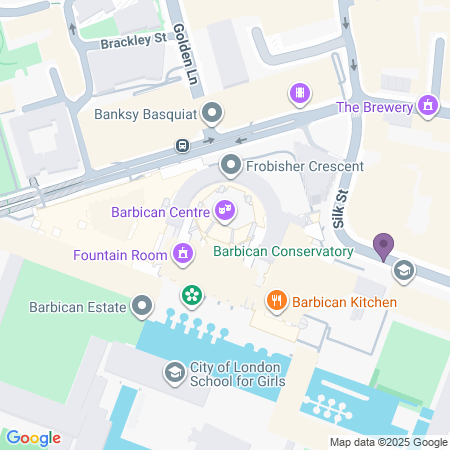
Travel Information
Nearest Tube station
- Moorgate
- Barbican
Nearest Rail Station
- Moorgate
Tube lines
- Circle
- Hammersmith & City
- Metropolitan
- Northern
Day buses
- (Beech Street) 76, 153; (City Road) 21, 43, 141, 205, 214, 271
Night buses
- (Beech Street) N76; (City Road) 43, 205, 214, 271
Barbican Theatre Frequently Asked Questions
How do I get to the Barbican Theatre?
The theatre sits inside the Barbican Centre on Silk Street, EC2Y 8DS, in the City. Barbican station — Circle, Hammersmith & City and Metropolitan lines — is about four minutes' walk, with Moorgate and St Paul's seven to eleven. Car parks are within the complex itself, on Beech Street and Silk Street. The estate is famously confusing on foot: follow the painted line and the signs for Silk Street rather than trusting a map.
Is the Barbican Theatre an accessible space?
Yes, and thoroughly so — one advantage of a building designed in the 1970s rather than adapted from the Victorian era. A ramped main entrance on Silk Street gives step-free access to the Level G foyer, and lifts and ramped routes serve every floor. Wheelchair users can choose four spaces in Stalls row T or four in Upper Circle row B, with theatre lifts linking the levels. Accessible unisex toilets are inside the theatre on the Mezzanine and on every level of the centre. Hearing support runs through induction loops and headsets, and live-captioned, BSL-interpreted and audio-described performances are scheduled regularly.
What time should I arrive at the Barbican Theatre?
Allow more than the usual thirty minutes on a first visit — forty-five is wiser. The Barbican is a large complex and finding the theatre within it takes longer than finding the building. Once you are in, the time is well spent: there are bars, a restaurant, the conservatory on some days, and the foyers themselves are worth a wander.
Is there a dress code at the Barbican Theatre?
None whatever, and this is one of the least formal audiences in London — a house that programmes international theatre, dance and film draws people straight from work as readily as from dinner. Dress for comfort over a long sitting, and bring a layer: the concrete interiors hold their temperature and can feel cool even in summer.
Can I take photographs inside the Barbican Theatre?
Not while the performance is on — no photographs, no video. Before it, afterwards and during the bows you are free to. The building rewards a camera more than most theatres do: the brutalist foyers, the lake terrace and the stacked walkways are the reason a good many people photograph the Barbican without ever seeing a show in it.
Does the Barbican Theatre have a cloakroom, and is there a charge?
Yes, and it is free. Bags and coats can be left there before the performance; a voluntary donation of around £2 is invited, which goes to the centre rather than being a charge you must pay. Given the size of the building it is the sensible option — you may well walk further inside than you did to get here.
Barbican Theatre history
From the outside
One poll voted The Barbican London’s ugliest building. Ugly or not, it certainly has presence. It’s an enormous, block-like masterpiece with its roots in Brutalist architecture, but it’s slowly settling into its surroundings and these days The Barbican Centre blends into the everyday London landscape. Because it’s modern and purpose built, the facilities are excellent and the indoor spaces completely fit for purpose.
Barbican Theatre architecture and history
Just sixty years ago, the land the Barbican stands on was an abandoned brownfield site that hadn’t been touched since it was flattened by bombs in the Second World War. It was a serious eyesore in an area that was once home to William Shakespeare, Thomas More and Ben Johnson.
Built in 1982, The Barbican Centre is still Europe’s biggest performing arts centre. It hosts classical and contemporary music, theatre, film and art exhibitions and there’s also a fantastic library, three restaurants and a smart conservatory. This is the home of the prestigious London and BBC Symphony Orchestras and the theatre itself is an integral part of the centre.
The auditorium is designed with seats forming an intimate semi-hexagon which hugs the rectangular stage, with no boxes but extra forward-facing seats for excellent visibility. The décor is currently a symphony in coffee and chestnut, which gives it a cosy feel despite the auditorium’s impressive size. No gold leaf or carving… but a superb contemporary theatre experience in comfort ad style.
Now Grade Two listed, the Centre took a long eleven years to build, finally opening to a mixed reception spanning delight, horror and everything in between. Its looks were controversial and any felt it looked out of date before it was even finished. In the 1990s steps were taken to soften its looks, with statues and decorations. And in the 2000s the addition of bold signs and painted lines made it easier to people to find their way around.
The Centre was the official London home of the prestigious Royal Shakespeare Company from ’82 to 2002. Their departure made way for year-round international productions. In 2007 the entire Centre enjoyed a £35 million redesign to celebrate 25 years on the site.
The entrance to the Silk Street Theatre is via the main Barbican Centre entrance in Silk Street. If you’ve booked tickets for a Guildhall School production, you should use the Guildhall School entrance on Silk Street.
Past shows at the Barbican Theatre
Before 2002, The Royal Shakespeare Company dominated the Barbican Theatre. Since then it has hosted any number of top shows, including the smash hit vintage musical South Pacific.
Barbican Theatre access
The main Silk Street entrance has a ramp. Lifts provide access to every level at the Barbican Theatre, and all Barbican venues have seating for wheelchair users.
Barbican Theatre tickets
We’re a popular destination for a wide variety of seat types and prices, with excellent availability on the full range of Barbican Theatre tickets.