
Review: BROKEN GLASS at the Young Vic
BROKEN GLASS — a reference to the 1938 Kristallnacht persecution of Jews in Germany — become’s the triggering catalyst causing a woman to experience physical disability. But what other subconscious factors closer to home underpin her partial paralysis?
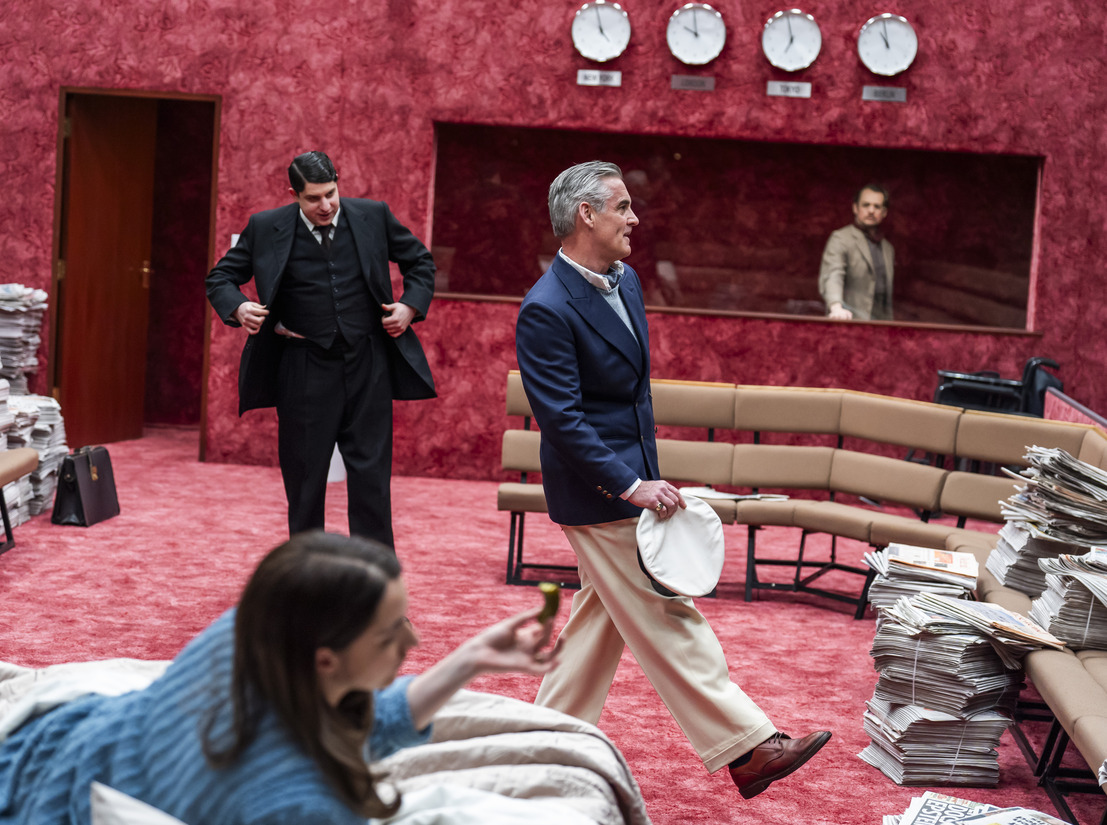 Pearl Chanda, Eli Gelb, Nigel Whitmey, Alex Waldmann in BROKEN GLASS at the Young Vic. Photo by Tristram Kenton.
Arthur Miller’s 1994 work is set in Brooklyn, where Sylvia Gellburg (Pearl Chanda) has recently experienced an episode which has rendered her paralysed from the waist down. Her husband Phillip (Eli Gelb) is the only Jewish employee at a mortgage and loan bank run by Stanton Case (Nigel Whitney) where he is responsible for foreclosures. Treating Sylvia, is Dr Hyman (Alex Waldmann) who has something of a reputation with the ladies and unusually for a Jew we are told, enjoys riding horses. Margaret Hyman (Nancy Carroll) his wife, has a chatty vivacity which hides the deep rooted hurt she feels from her husband’s undoubted infidelities. Finally, Sylvia’s well-meaning sister Harriet (Juliet Cowan) serves to flutter and divulge a few private facts which help move the narrative needle.
Directed by Jordan Fein, the cast (all of whom seem too young for their roles) play their scenes along an enclosed parade thrust which designer Rosanna Vize has covered in a dark pink deep pile carpet. The edges are adorned with seating and downstage is a double bed. Upstage, a large glass panel heralds the arrival and departure of characters from scenes.
Stylistically we’ve landed in late-thirties New York with the furniture, costumes and hairstyles of the period. But as Sylvia feeds her morbid fascination for the rising Nazi atrocities in Germany by scouring the newspapers strewn and stacked liberally about the set, it is obvious to any audience member that modern British newspapers make up the majority of those on show, which feels like a glaring oversight. If it is a conscious design choice, it feels inexplicably incongruous. If an error, then it should be rectified. If it holds some significant subversive meaning, it was lost on me. If it was simply an amusing ruse specifically aimed at press night attendees, then I suspect the joke might not necessarily play as smart.
Given that the play continually scratches at the itch of awkwardness and embarrassment experienced by couples (even those who have shared intimacy and been together for decades), there is another incongruity in approach here which appears to be a flawed directorial choice. Nowadays we live in an age where we are all encouraged to undergo therapy, couples’ counselling and indeed share our emotional responses to anything and everything, but the idea that two individuals in 1938 — namely a doctor and patient (but also a doctor and his patient’s husband) — could be so openly touchy-feely as to lay/sit/kneel on a bed together chatting and manhandling each other as though it is the most natural thing in the world, is utterly preposterous and jarring.
Miller’s later works were a far cry from the heady output he achieved in his heyday, but there are occasional nuggets which remind us of his brilliance, my personal favourite being The Last Yankee completed around the same time. This production of BROKEN GLASS however, is a far cry from Henry Goodman’s memorable 1994 turn at the National. It proves a tetchy vehicle given few opportunities for levity and stodgily imbued with characterisations which rarely break free from sour introspection (save Margaret’s occasional braying laugh). In lesser hands, the play lacks the intensity and interest derived from a ground down Willy Loman or the infinite watchability of a manipulative Abigail Williams. Consequently, the vehicle parks itself predictably, having resolutely refused at any point during the journey to slip into fourth gear.
BROKEN GLASS continues at Young Vic until 18th April and runs 2 hours straight through without interval.
Latest News
 Review: MARTIN GUERRE at The Old Vic
21 October 2026 at 00:31
Review: MARTIN GUERRE at The Old Vic
21 October 2026 at 00:31
 Casting announced for PRETTY WOMAN: THE MUSICAL
20 October 2026 at 11:53
Casting announced for PRETTY WOMAN: THE MUSICAL
20 October 2026 at 11:53
 Review: DOG MOM at Southwark Playhouse Borough
17 October 2026 at 00:35
Review: DOG MOM at Southwark Playhouse Borough
17 October 2026 at 00:35
 THE GUILTY to transfer to West End in 2027
16 October 2026 at 15:55
THE GUILTY to transfer to West End in 2027
16 October 2026 at 15:55